

Convex Lens vs Concave Lens: Key Differences Explained
Table of Contents
Selecting the right lens type is a critical decision that directly impacts the performance of your optical system. Whether you are designing a camera module, developing medical imaging equipment, or sourcing components for industrial inspection systems, the choice between convex and concave lenses will determine image quality, system efficiency, and overall project success. Both lens types are fundamental optical components with distinct light-bending properties. However, using the wrong type may result in blurred images, system malfunction, or costly redesigns.
This comprehensive guide covers everything you need to know about convex and concave lenses, including their working principles, image formation characteristics, key differences, and application scenarios.
What is a Convex Lens?
Structure and Shape
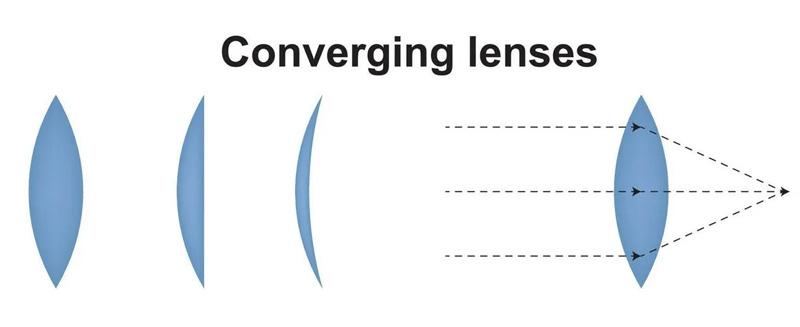
A convex lens has a curved surface that bulges outward. The center is thicker than the edges. This shape causes light rays to bend inward when they pass through.
Three subtypes of convex lenses:
| Type | Shape | Best For |
|---|---|---|
| Biconvex | Both surfaces curved outward | Imaging nearby objects |
| Plano-convex | One flat, one curved surface | Focusing distant light sources |
| Convex-meniscus | One surface slightly concave | Reducing aberrations |
How Convex Lenses Handle Light
When parallel light rays enter a convex lens, they refract inward and meet at a point called the focal point. This point is on the opposite side of the lens from the light source. The distance from the lens center to the focal point is the focal length.
Convex lenses are called converging lenses because they bring light together.
Image Formation
Convex lenses can form two types of images:
Real images: When the object is beyond the focal point, light rays converge on the other side of the lens. The image is inverted and can be projected onto a screen.
Virtual images: When the object is between the lens and the focal point, light rays diverge after passing through. The image appears upright and magnified on the same side as the object.
What is a Concave Lens?
Structure and Shape
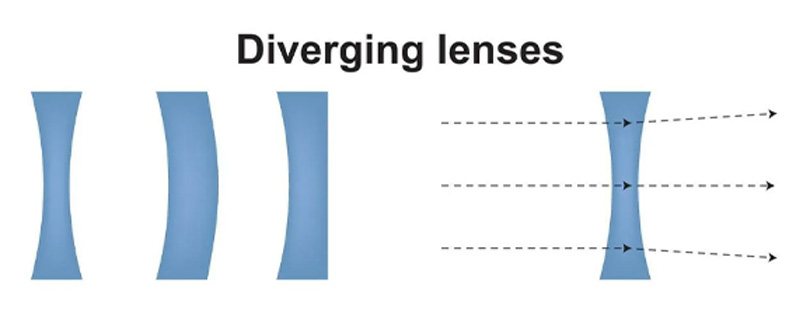
A concave lens curves inward like a bowl. The center is thinner than the edges. This shape causes light rays to spread apart when they pass through.
Three subtypes of concave lenses:
| Type | Shape | Best For |
|---|---|---|
| Biconcave | Both surfaces curved inward | Maximum light divergence |
| Plano-concave | One flat, one curved inward | Beam expansion |
| Concave-meniscus | One surface slightly convex | Specific optical systems |
How Concave Lenses Handle Light
When parallel light rays enter a concave lens, they refract outward and spread apart. The rays never actually meet. If you trace them backward, they appear to come from a point on the same side as the light source. This is the virtual focal point.
Concave lenses are called diverging lenses because they spread light apart.
Image Formation
Concave lenses always form virtual images. The image characteristics are constant regardless of object position:
| Object Position | Image Type | Image Orientation | Image Size |
|---|---|---|---|
| Any distance | Virtual | Upright | Reduced |
The image always appears smaller than the object and on the same side as the object.
Common Applications
- Peepholes: Provide wide-angle view through doors
- Laser beam expanders: Spread laser beams to larger diameters
- Flashlights: Control light spread patterns
- Optical instruments: Correct aberrations when combined with convex lenses
- Viewfinders: Create compact optical paths in cameras
Key Differences Between Convex and Concave Lenses
Understanding the fundamental differences between these two lens types helps engineers and designers select the right component for their optical systems.
Structural Differences
| Feature | Convex Lens | Concave Lens |
|---|---|---|
| Center thickness | Thicker than edges | Thinner than edges |
| Edge thickness | Thin | Thick |
| Surface curvature | Bulges outward | Curves inward |
| Cross-section shape | Similar to a football | Similar to a bowl |
Light Behavior Differences
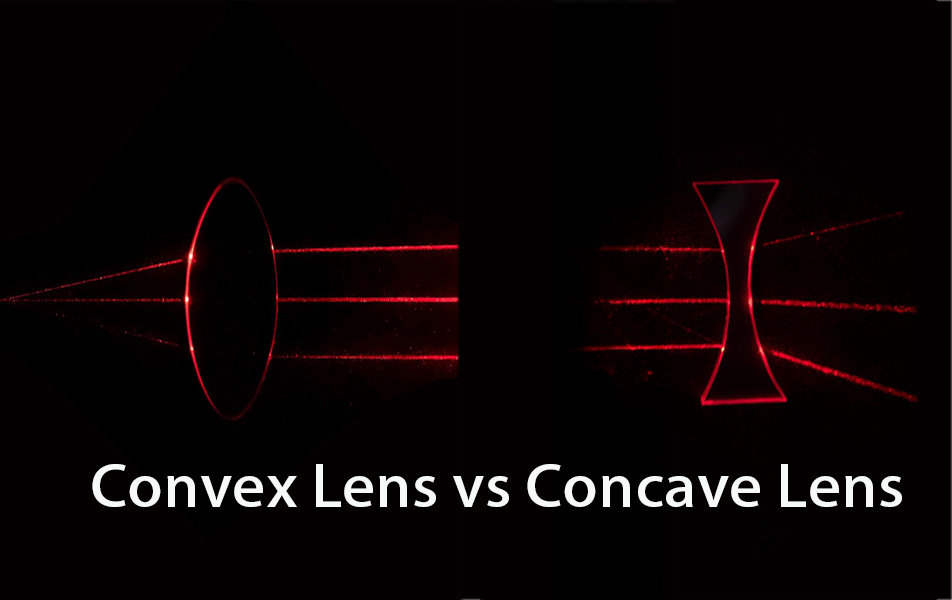
Convex lenses converge light. Parallel rays entering the lens bend toward the optical axis and meet at a real focal point on the opposite side. This concentration of light makes convex lenses ideal for focusing applications.
Concave lenses diverge light. Parallel rays bend away from the optical axis and spread apart after passing through. The rays never physically converge, which makes concave lenses useful for expanding beams or correcting optical aberrations.
Image Formation Differences
| Characteristic | Convex Lens | Concave Lens |
|---|---|---|
| Image type | Real or virtual (depends on object position) | Always virtual |
| Image orientation | Inverted (real) or upright (virtual) | Always upright |
| Image size | Magnified or reduced | Always reduced |
| Image location | Either side of lens | Same side as object |
| Can project image | Yes (real images) | No |
Focal Length Differences
Focal length sign convention is critical for optical calculations.
Convex lenses have a positive focal length (+f). The focal point exists on the opposite side of the lens from the incoming light, where rays physically converge.
Concave lenses have a negative focal length (−f). The focal point is virtual and located on the same side as the incoming light. Rays only appear to originate from this point when traced backward.
This sign convention directly affects lens equations. When calculating image distance, magnification, or combining multiple lenses, using the correct sign ensures accurate results.
How to Identify Lens Types
When working with unmarked lenses or verifying component specifications, two simple methods allow quick identification.
Touch Method
Run your finger across the center and edge of the lens surface.
For a convex lens, the center feels noticeably thicker than the edges. Your finger will detect a raised, curved surface in the middle that gradually thins toward the perimeter.
For a concave lens, the center feels thinner than the edges. The middle section dips inward while the perimeter remains relatively thick.
This method works well for lenses with pronounced curvature but may be difficult for lenses with very long focal lengths where the thickness variation is subtle.
Observation Method
Hold the lens at arm’s length and look at a distant object or text through it.
Through a convex lens, distant objects appear inverted (upside down) when viewed from beyond the focal length. If you move the lens closer to your eye (within the focal length), objects appear magnified and upright.
Through a concave lens, objects always appear smaller and upright regardless of distance. The image shrinks but maintains its orientation.
Alternatively, hold the lens above printed text and slowly raise it. A convex lens magnifies the text initially, then inverts it as the distance increases. A concave lens consistently reduces the text size at all distances.
Conclusion
Most advanced optical systems—cameras, microscopes, telescopes—use both lens types together. Convex lenses do the heavy lifting of focusing and magnifying. Concave lenses correct aberrations and fine-tune the optical path. Understanding how each works helps you design better systems and troubleshoot problems.
Need custom lenses for your project? Star-optics provides precision convex and concave lenses in BK7, K9, fused silica, and other optical materials. Whether you need standard components or custom designs, our engineering team can help you find the right solution.
