

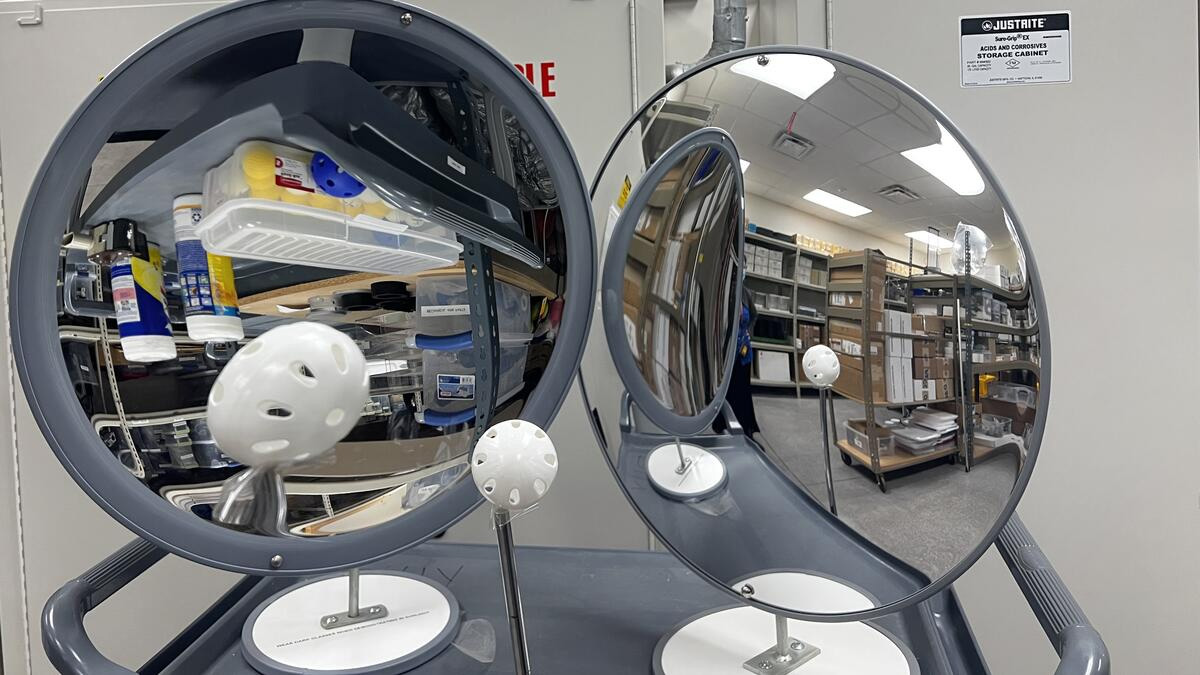
Concave vs Convex Mirror: Key Differences, Image Formation, and Applications
Table of Contents
Mirrors are more than just reflective surfaces—they are precision optical components that shape how we see and interact with the world. Whether you’re designing a car’s side mirror, building a telescope, or creating a security system, understanding the fundamental differences between concave and convex mirrors is essential. In this comprehensive guide, we’ll explore how these two mirror types work, how they form images, and which applications they serve best.
What Is a Concave Mirror?

A concave mirror, also known as a converging mirror, features a reflective surface that curves inward, similar to the inside of a spoon. When parallel light rays strike a concave mirror, they converge at a single point called the focal point, which lies in front of the mirror.
Key characteristics of concave mirrors:
- The reflective surface curves inward (cave-like)
- Light rays converge after reflection
- Can produce both real and virtual images depending on object position
- Has a positive focal length
- The center of curvature and focal point are located in front of the mirror
The behavior of a concave mirror depends significantly on where the object is placed relative to its focal point. This unique property makes concave mirrors extremely versatile in optical applications ranging from makeup mirrors to astronomical telescopes.
What Is a Convex Mirror?

A convex mirror, also called a diverging mirror, has a reflective surface that curves outward, like the back of a spoon. When parallel light rays hit a convex mirror, they spread apart (diverge) after reflection, appearing to originate from a virtual focal point behind the mirror.
Key characteristics of convex mirrors:
- The reflective surface curves outward (bulges toward the light source)
- Light rays diverge after reflection
- Always produces virtual, upright, and diminished images
- Has a negative focal length
- The center of curvature and focal point are located behind the mirror
Unlike concave mirrors, convex mirrors provide a wider field of view, making them ideal for applications where seeing a broader area is more important than magnification.
Concave vs Convex Mirror: How They Reflect Light
The fundamental difference between concave and convex mirrors lies in how they interact with light rays.
Concave Mirror Reflection: When parallel light rays strike a concave mirror, they reflect and converge at the focal point. This convergence is what allows concave mirrors to focus light and create magnified images. The angle of incidence equals the angle of reflection, but because the surface curves inward, all reflected rays meet at a common point.
Convex Mirror Reflection: Convex mirrors cause parallel light rays to diverge upon reflection. While the same law of reflection applies, the outward-curving surface causes each reflected ray to spread away from the others. If you trace these diverging rays backward, they appear to meet at a virtual focal point behind the mirror.
This fundamental difference in light behavior determines everything from image characteristics to practical applications.
Image Formation: Real vs Virtual Images
Understanding image formation is crucial when selecting the right mirror for your application.
Concave Mirror Image Formation
The type of image formed by a concave mirror depends on the object’s distance from the mirror:
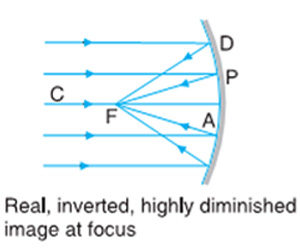
1.When the object is placed at a very far distance from the concave mirror, well beyond the center of curvature C, the reflected rays converge to form a real image at the focal point F. This image is inverted and highly diminished compared to the original object.
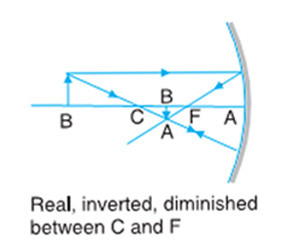
2.When the object is positioned beyond the center of curvature C but not extremely far away, the image forms between the center of curvature C and the focal point F. The resulting image is real, inverted, and diminished in size, meaning it appears smaller than the actual object.
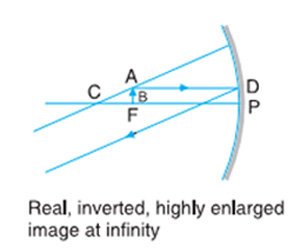
3.When the object is placed very close to the focal point F but slightly beyond it, the reflected rays are nearly parallel and converge at an extremely distant point. This produces a real, inverted image that is highly enlarged and forms at infinity.
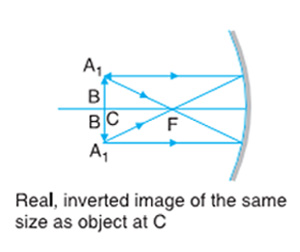
4.When the object is placed exactly at the center of curvature C, the image also forms at the center of curvature C. This image is real, inverted, and exactly the same size as the object. This is the only position where the object and image are equal in size.
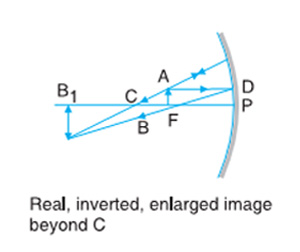
5.When the object is located between the center of curvature C and the focal point F, the image forms beyond the center of curvature C. The resulting image is real, inverted, and enlarged, appearing larger than the original object.
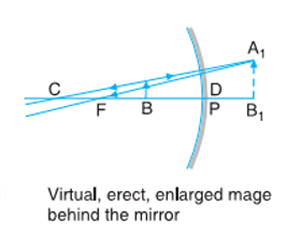
6.When the object is placed between the focal point F and the mirror surface, the reflected rays diverge and appear to originate from a point behind the mirror. This creates a virtual, erect, and enlarged image that cannot be projected onto a screen because it forms behind the mirror.
Convex Mirror Image Formation
Convex mirrors are much simpler in their image formation:
- Always virtual: The image forms behind the mirror
- Always upright: The image maintains the same orientation as the object
- Always diminished: The image is smaller than the actual object
- Always located between the focal point and the mirror surface
This consistency makes convex mirrors predictable and reliable for specific applications.
Common Uses of Concave Mirrors
Concave mirrors excel in applications requiring light concentration or image magnification:
1. Reflecting Telescopes Astronomical telescopes use large concave mirrors to gather and focus light from distant celestial objects, enabling us to observe stars, planets, and galaxies.
2. Solar Concentrators Solar power systems use concave mirrors to concentrate sunlight onto a small area, generating intense heat for power generation.
3. Medical and Dental Instruments Doctors and dentists use concave mirrors in head mirrors and examination tools to focus light and magnify areas of interest.
Common Uses of Convex Mirrors
Convex mirrors are chosen when a wide field of view is more important than magnification:
1. Vehicle Side Mirrors Passenger-side mirrors on vehicles are convex, providing drivers with a wider view of traffic behind and beside them. The warning “Objects in mirror are closer than they appear” refers to the diminished image size.
2. Security and Surveillance Convex mirrors in retail stores, warehouses, and parking garages allow security personnel to monitor large areas from a single vantage point.
3. Road Safety Mirrors At blind corners, intersections, and driveways, large convex mirrors help drivers see oncoming traffic that would otherwise be hidden.
Conclusion
Concave and convex mirrors serve fundamentally different purposes in optics, and understanding their unique properties is essential for selecting the right solution for your needs. Concave mirrors converge light and offer versatile image formation capabilities, making them ideal for magnification, focusing, and precision applications. Convex mirrors diverge light and consistently produce wide-angle views, making them indispensable for safety, security, and surveillance applications.
At Star-optics, we manufacture high-quality optical mirrors for industrial, scientific, and commercial applications. Whether you need precision concave mirrors for optical instruments or durable convex mirrors for security systems, our team can help you find the perfect solution. Contact us today to discuss your specific requirements and discover how our optical expertise can support your project.
