

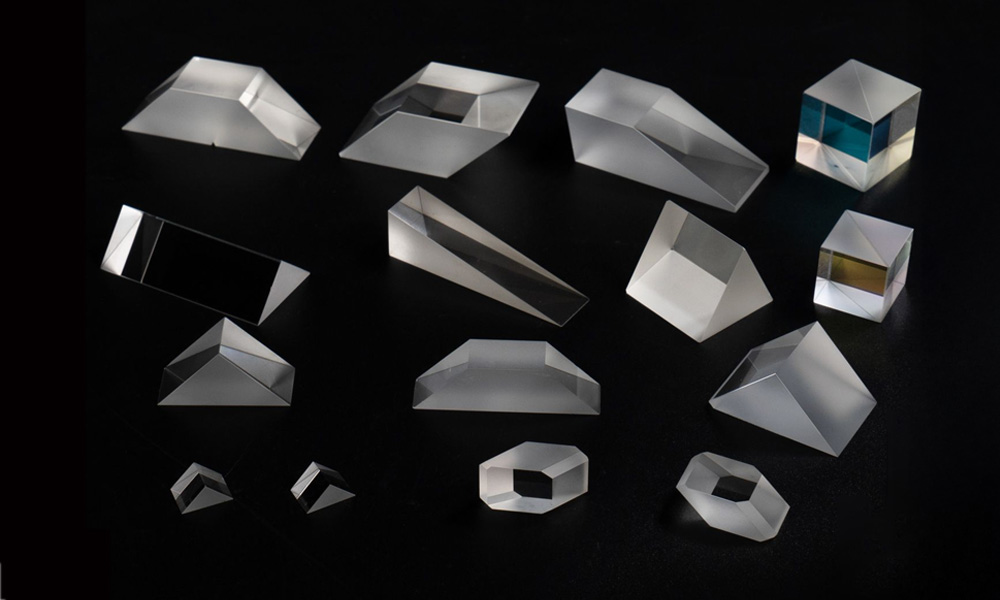
What Are Optical Prisms?
Table of Contents
Optical prisms change the path of light through refraction and reflection to achieve dispersion, deviation, or image correction. They are widely used in science, industry, medicine, and daily life, serving as essential components of modern optical systems.
Optical prisms are powerful tools that shape the way you see and interact with light. These transparent solid objects with flat, polished surfaces can bend, split, and redirect light in remarkable ways. Whether you’re observing a rainbow through a glass prism or using binoculars to watch distant wildlife, prisms make it possible. They play a vital role in modern technology, from spectroscopy to camera systems. By understanding how they work, you can appreciate their impact on daily life and unlock their full potential.
What Are Optical Prisms?
Definition and Function
Optical prisms are transparent solid objects with flat, polished surfaces that refract, reflect, or disperse light. Unlike lenses, which have curved surfaces, prisms typically feature planar faces arranged at precise angles. The most familiar form is the triangular prism, but prisms come in many shapes including rectangular, pentagonal, and polygonal configurations.
When you think about optical prisms, consider their role in splitting white light into a beautiful spectrum or correcting the orientation of images in your binoculars. They are not just scientific tools; they are gateways to understanding light itself. Whether you’re using a spectrometer to analyze chemical composition or a periscope to see around corners, prisms make it all possible.
The primary functions of optical prisms include:
- Dispersion: Separating white light into its component wavelengths (colors)
- Deviation: Bending light at specific angles
- Reflection: Redirecting light through total internal reflection
- Image rotation: Inverting or rotating images in optical systems
How Optical Prisms Work
Optical prisms work through two main mechanisms: refraction and total internal reflection.
Refraction occurs when light passes from one medium to another with a different refractive index. As light enters a prism, it bends according to Snell’s Law. The degree of bending depends on the angle of incidence and the refractive index of the prism material. Different wavelengths of light bend by slightly different amounts, which is why prisms can separate white light into a spectrum.
Total internal reflection happens when light strikes a surface at an angle greater than the critical angle. Instead of passing through, the light reflects entirely back into the prism. This phenomenon allows prisms to redirect light with nearly 100% efficiency, superior to metallic mirrors.
Imagine holding a glass prism under sunlight. The prism bends each color of light by a different amount, spreading the white light into a rainbow. This is dispersion in action. The shape and material of the prism determine how effectively it manipulates light.
Tip: The amount of dispersion depends on both the prism’s apex angle and the material’s dispersive power. Flint glass provides more dispersion than crown glass.
Key Properties of Optical Prisms
The properties of optical prisms directly influence their performance. Here are some key factors to consider:
- Apex angle: The angle between the two refracting surfaces determines the deviation and dispersion of light. Larger apex angles produce greater deviation.
- Refractive index: Higher refractive indices cause more bending of light. Different materials offer different refractive indices for various applications.
- Dispersion: The variation of refractive index with wavelength determines how much a prism spreads different colors. This is quantified by the Abbe number.
- Surface quality: Polished, flat surfaces are essential for clear, undistorted light transmission and reflection.
These properties make each prism unique. For example, a high-dispersion flint glass prism is ideal for spectroscopy, while a low-dispersion crown glass prism works better for beam steering. By understanding these characteristics, you can make informed decisions when selecting prisms for specific applications.
Types of Optical Prisms
Optical prisms come in various forms, each designed to manipulate light in unique ways. Understanding their differences can help you choose the right prism for your needs. Let’s explore the main types based on shape, function, and material.
Based on Shape
Triangular Prisms
Triangular prisms are the most recognizable type, featuring three rectangular faces and two triangular bases. These prisms are primarily used for dispersing light into its spectrum. The standard equilateral triangular prism has a 60-degree apex angle, which provides a good balance between dispersion and light transmission.
When white light enters a triangular prism, each wavelength bends at a slightly different angle. Violet light, with its shorter wavelength, bends more than red light. This creates the familiar rainbow spectrum that Newton first systematically studied in 1666.
Right-Angle Prisms
Right-angle prisms have one 90-degree angle and two 45-degree angles. They redirect light by 90 degrees or 180 degrees through total internal reflection. These prisms are commonly used in periscopes, beam-steering systems, and optical instruments where precise light redirection is needed.
The simplicity of their geometry makes right-angle prisms easy to manufacture and align in optical systems.
Pentaprisms
Pentaprisms are five-sided prisms that deviate light by exactly 90 degrees regardless of the input angle. Unlike simpler prisms, pentaprisms produce images that are neither inverted nor reversed. This property makes them essential in single-lens reflex (SLR) cameras, where they ensure the photographer sees a correctly oriented image through the viewfinder.
Dove Prisms
Dove prisms are truncated right-angle prisms that can rotate images. When you rotate the prism around its optical axis, the transmitted image rotates at twice the speed. This unique property makes dove prisms valuable in image rotation systems and interferometers.
Here’s a quick comparison to help you visualize the differences:
| Prism Type | Shape Description | Primary Function | Common Applications |
|---|---|---|---|
| Triangular | Three rectangular faces, two triangular bases | Disperses light into spectrum | Spectroscopy, education |
| Right-Angle | 90° and two 45° angles | Redirects light by 90° or 180° | Periscopes, beam steering |
| Pentaprism | Five-sided polygon | 90° deviation without inversion | SLR camera viewfinders |
| Dove | Truncated right-angle | Image rotation | Interferometers, rotators |
1.Based on Function
Dispersive Prisms
Dispersive prisms are designed to separate light into its component wavelengths. They exploit the fact that different colors of light refract by different amounts. These prisms are fundamental to spectrometers, monochromators, and any system requiring wavelength analysis.
Common dispersive prisms include:
- Equilateral prisms: Standard 60-degree prisms for visible light dispersion
- Littrow prisms: Used in tunable lasers for wavelength selection
- Pellin-Broca prisms: Provide constant deviation for spectroscopic applications
Reflective Prisms
Reflective prisms use total internal reflection to redirect light without dispersion. By ensuring light strikes internal surfaces above the critical angle, these prisms achieve nearly perfect reflection efficiency without metallic coatings.
Common reflective prisms include:
- Porro prisms: Invert images using two total internal reflections; used in binoculars
- Roof prisms: Combine image inversion with lateral reversal; enable compact binoculars
- Corner cube retroreflectors: Return light parallel to its incident direction
Did You Know? Reflective prisms can achieve reflection efficiencies above 99%, while typical metallic mirrors only achieve 85-95% reflectivity.
Polarizing Prisms
Polarizing prisms separate light into two orthogonally polarized beams. They exploit birefringent materials like calcite, which have different refractive indices for different polarization states.
Common polarizing prisms include:
- Nicol prisms: The original polarizing prism design
- Glan-Thompson prisms: High extinction ratio for precision applications
- Wollaston prisms: Separate beams diverge symmetrically
2.Based on Material
Glass Prisms
Glass prisms offer excellent optical clarity and durability. They are available in many types:
- Crown glass: Low dispersion, ideal for beam steering
- Flint glass: High dispersion, perfect for spectroscopy
- BK7: The most common optical glass, offering good all-around performance
Glass prisms resist scratches well and are relatively affordable. However, they can be heavy and may not transmit ultraviolet or infrared light effectively.
Crystal Prisms
Crystal prisms provide specialized optical properties:
- Fused silica: Excellent UV transmission for ultraviolet spectroscopy
- Calcium fluoride (CaF₂): Transmits from UV to mid-infrared
- Calcite: Strong birefringence for polarization applications
Crystal prisms are typically more expensive but essential for demanding applications outside the visible spectrum.
Plastic Prisms
Plastic prisms, often made from acrylic (PMMA) or polycarbonate, are lightweight and impact-resistant. While their optical quality is generally lower than glass or crystal, they are ideal for applications where cost, weight, or safety are priorities.
| Material | Advantages | Disadvantages | Best Applications |
|---|---|---|---|
| Glass | Excellent clarity, durable, variety of types | Heavier, limited spectral range | General optics, spectroscopy |
| Crystal | Wide spectral range, specialized properties | Expensive, some are fragile | UV/IR systems, polarimetry |
| Plastic | Lightweight, impact-resistant, low cost | Lower optical quality | Consumer products, education |
3.Specialized Prisms
Porro Prisms
Porro prisms are a marvel of optical engineering. They use two right-angle prisms arranged to invert an image both vertically and horizontally. This design is essential in traditional binoculars, where the objective lenses produce inverted images that must be corrected for comfortable viewing.
The offset design of Porro prism binoculars creates their characteristic zigzag shape, which many users find ergonomically comfortable for extended viewing sessions.
Anamorphic Prism Pairs
Anamorphic prism pairs expand or compress beams in one dimension without affecting the other. They transform elliptical laser diode outputs into circular beams, improving beam quality and coupling efficiency into optical fibers.
Here’s what makes anamorphic prisms stand out:
- Beam shaping: Convert elliptical beams to circular profiles
- No wavelength dispersion: Careful design minimizes chromatic effects
- Compact design: Achieve significant beam expansion in small packages
Corner Cube Retroreflectors
Corner cube prisms return light exactly parallel to its incident direction, regardless of the input angle (within limits). Three mutually perpendicular surfaces create this effect through three total internal reflections.
| Feature | Porro Prisms | Anamorphic Prism Pairs | Corner Cube Retroreflectors |
|---|---|---|---|
| Design | Two right-angle prisms | Two wedge prisms | Three perpendicular surfaces |
| Key Benefit | Image inversion | Beam shaping | Precise light return |
| Applications | Binoculars, telescopes | Laser diode systems | Surveying, laser ranging |
Fun Fact: Corner cube retroreflectors were left on the Moon by Apollo astronauts. Scientists on Earth bounce laser beams off them to measure the Earth-Moon distance with centimeter precision!
Conclusion
Optical prisms are versatile tools that disperse, redirect, and manipulate light across countless applications. From scientific research to everyday devices, understanding prism types helps you select the right solution for your optical needs.
