
Anti-Glare vs Anti-Reflective: What’s the Difference?
Table of Contents
Introduction
When selecting glass for displays, optical systems, or protective covers, two terms frequently appear: anti-glare (AG) and anti-reflective (AR). While both technologies aim to improve visual performance by managing unwanted light, they work in fundamentally different ways and serve distinct purposes.
Many engineers and product designers use these terms interchangeably, leading to specification errors and suboptimal product performance. Anti-glare scatters light through surface texture, while anti-reflective eliminates reflections through thin-film interference. Understanding this distinction is essential for choosing the right solution for your application.
This guide explains the working principles, key differences, and application scenarios for both AG and AR technologies, helping you make informed decisions for your optical component requirements.
What Is Anti-Glare (AG) Glass?
Anti-glare glass solves a specific problem: reducing the mirror-like reflections that make screens difficult to read under bright lighting conditions. Rather than eliminating reflections entirely, AG treatment converts sharp, concentrated reflections into soft, diffused light that is far less distracting to the eye.
How Anti-Glare Works
The principle behind anti-glare is surface light scattering. By creating microscopic irregularities on the glass surface, incoming light reflects in multiple directions rather than as a single coherent beam. This diffusion effect significantly reduces the intensity of reflected images, making the underlying display content easier to see even when ambient light sources are present.
Common AG Manufacturing Methods
Chemical Etching (Etched AG Glass) Chemical etching uses controlled acid treatment to create a uniform matte texture on the glass surface. This method produces highly consistent results and allows precise control over the degree of surface roughness. Etched anti-glare glass is widely used in high-volume display applications where uniformity is critical.
Spray Coating AG coatings apply a thin layer of particles to the glass surface, creating light-scattering texture. This approach offers flexibility in adjusting the anti-glare intensity and can be applied to various substrate materials.
Sandblasting Mechanical sandblasting physically roughens the glass surface. While less precise than chemical etching, this method is cost-effective for certain industrial applications.
Key Characteristics of AG Glass
Anti-glare glass exhibits several distinctive properties:
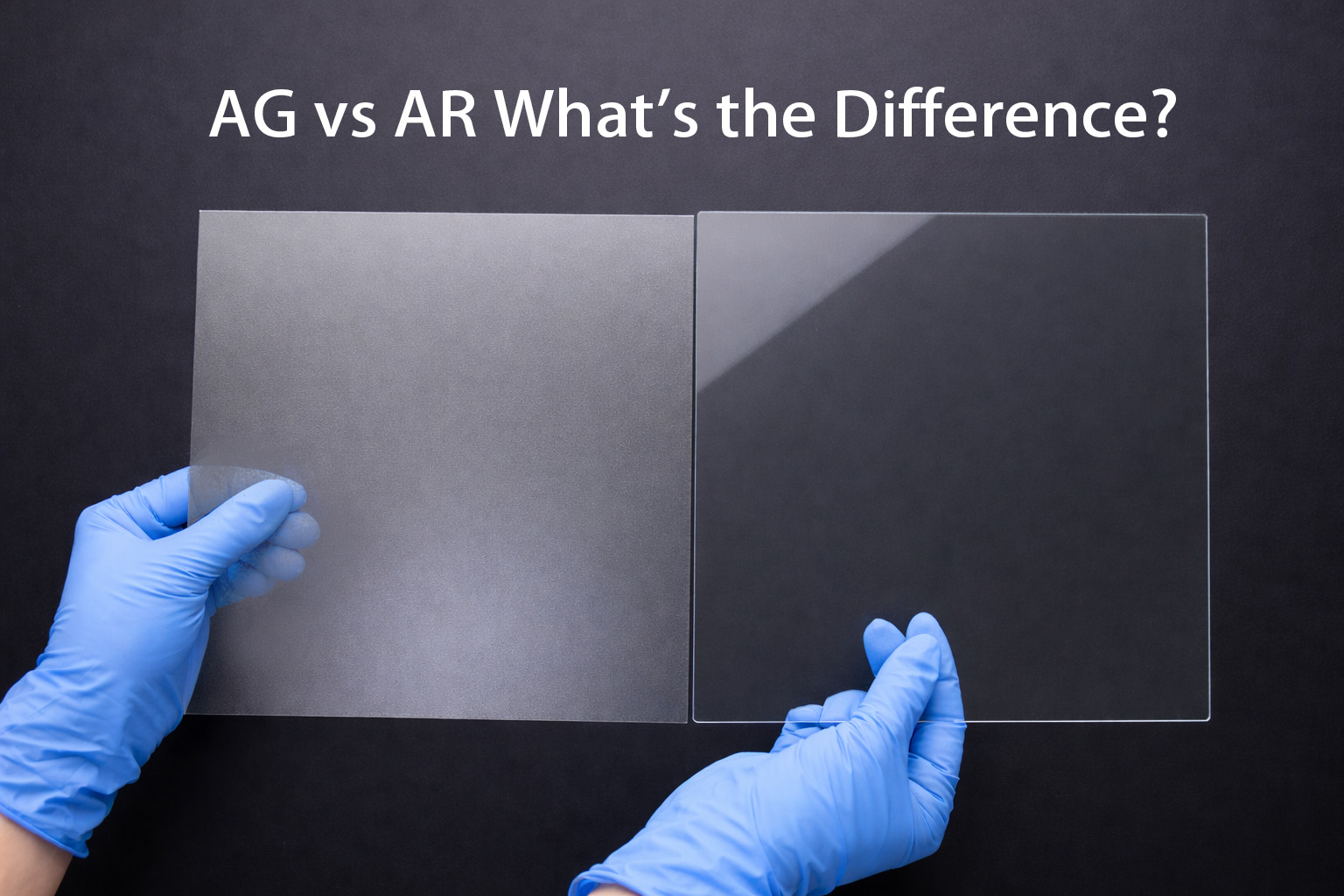
- Matte surface appearance: The textured surface gives AG glass a slightly frosted look compared to standard clear glass
- Reduced specular reflection: Mirror-like reflections are converted to diffuse reflections, typically reducing glare by 70-90%
- Slight haze: The scattering effect introduces some haze, typically measured between 3% and 25% depending on the treatment intensity
- Minor clarity reduction: The diffusion that reduces glare also slightly softens image sharpness
AG Glass Specifications
| Parameter | Typical Range |
|---|---|
| Surface Gloss | 80-120 GU (60° measurement) |
| Haze | 3%-25% |
| Light Transmission | 85%-92% |
| Surface Roughness (Ra) | 0.1-1.0 μm |
What Is Anti-Reflective (AR) Coating?
Anti-reflective coating takes a completely different approach to managing unwanted reflections. Rather than scattering light, AR coating uses the physics of thin-film interference to cancel out reflected light waves, effectively making the glass surface nearly invisible.
How Anti-Reflective Coating Works
AR coating operates on the principle of destructive interference. When light hits a boundary between materials with different refractive indices, some portion reflects. By applying one or more thin layers of precisely controlled thickness, the light reflecting from the top of the coating and the light reflecting from the coating-glass interface can be made to arrive out of phase, canceling each other out.
For this cancellation to occur, the coating thickness must equal one-quarter of the target wavelength (λ/4). The coating material’s refractive index should ideally equal the square root of the glass substrate’s refractive index for optimal performance.
Common AR Coating Types
Single-Layer AR Coating The simplest AR coating uses a single layer of low-refractive-index material, typically magnesium fluoride (MgF₂) with n ≈ 1.38. Single-layer coatings can reduce reflection from approximately 4% to about 1.5% at the design wavelength, though performance degrades at other wavelengths.
Multi-Layer Broadband AR Coating For applications requiring low reflection across a wide spectral range, multi-layer AR coatings stack alternating high and low refractive index materials. Common material combinations include:
- MgF₂ / SiO₂ (low index layers)
- TiO₂ / Ta₂O₅ / ZrO₂ (high index layers)
Multi-layer designs can achieve reflection below 0.5% across the entire visible spectrum (400-700nm) or be optimized for specific wavelength ranges including UV, NIR, or IR.
BBAR (Broadband Anti-Reflective) Coating BBAR coatings provide consistent low reflection performance across extended wavelength ranges, commonly used in imaging systems and optical instruments where chromatic performance matters.
Key Characteristics of AR Coating
Anti-reflective coated glass offers distinct advantages:
- Extremely high transmission: AR coating can achieve >99% light transmission by virtually eliminating surface reflections
- Maintained image clarity: Unlike AG treatment, AR coating preserves full optical clarity with no haze or diffusion
- Clear, glossy appearance: AR coated surfaces remain optically smooth and transparent
- Wavelength-specific optimization: Coatings can be designed for specific spectral ranges
AR Coating Specifications
| Parameter | Typical Range |
|---|---|
| Reflectance (per surface) | 0.1%-0.5% |
| Light Transmission | 95%-99.5% |
| Wavelength Range | Custom (VIS, NIR, IR, UV) |
| Coating Layers | 1-8+ layers |
AR Coating Limitations
Despite superior optical performance, AR coatings have practical limitations:
- Higher cost: Vacuum deposition processes require specialized equipment and controlled environments
- Durability concerns: Some AR coatings can scratch or degrade over time, though hard AR coatings address this issue
- Cleaning sensitivity: Fingerprints and contamination are more visible on AR coated surfaces
- Environmental factors: Humidity and temperature extremes can affect certain coating types
Anti-Glare vs Anti-Reflective: Key Differences
Understanding the fundamental differences between AG and AR technologies is essential for proper specification. The following comparison highlights the key distinctions:
| Comparison Item | Anti-Glare (AG) | Anti-Reflective (AR) |
|---|---|---|
| Working Principle | Light scattering via surface texture | Thin-film interference |
| Reflection Reduction | Moderate (diffuses reflections) | Very high (eliminates reflections) |
| Light Transmission | 85%-92% | 95%-99.5% |
| Image Clarity | Slightly reduced (haze present) | Fully maintained |
| Surface Appearance | Matte / frosted | Clear / glossy |
| Manufacturing Process | Etching, coating, sandblasting | Vacuum deposition, sputtering |
| Relative Cost | Lower | Higher |
| Durability | High (surface treatment) | Varies (coating dependent) |
| Fingerprint Visibility | Low (texture hides marks) | High (marks clearly visible) |
| Best Environment | High ambient light, outdoor | Controlled lighting, indoor |
| Primary Benefit | Readable in bright conditions | Maximum optical performance |
The Core Distinction
The essential difference can be summarized simply:
- Anti-glare scatters light — it does not eliminate reflections but diffuses them so they become less concentrated and distracting
- Anti-reflective cancels light — it uses optical interference to prevent reflections from occurring in the first place
Neither technology is universally superior. The right choice depends entirely on your specific application requirements, operating environment, and performance priorities.
Which One Should You Choose?
Selecting between AG and AR depends on understanding your application’s specific requirements. The following guidelines address common use cases.
Display Screens and Touch Panels
For displays used in bright environments—retail kiosks, outdoor signage, industrial HMI panels, or automotive displays—anti-glare glass is typically the preferred choice. AG treatment ensures screen content remains readable even when direct sunlight or overhead lighting creates strong reflections.
Touch panels benefit from AG glass because the matte surface also reduces visible fingerprints and smudges, maintaining a cleaner appearance with less frequent cleaning.
Recommended: Anti-Glare (AG) glass for high ambient light environments
Optical Windows and Precision Lenses
Applications requiring maximum light transmission and optical clarity—camera lenses, microscope optics, telescope components, laser windows—demand anti-reflective coating. Any haze or diffusion introduced by AG treatment would degrade image quality unacceptably.
Multi-layer AR coatings optimized for specific wavelength ranges ensure maximum transmission while minimizing ghost images and flare caused by internal reflections.
Recommended: Multi-layer AR coating for imaging and optical systems
Camera and Machine Vision Systems
Industrial cameras, machine vision systems, and inspection equipment require pristine optical performance. AR coated protective windows and lens elements ensure maximum light reaches the sensor without introducing artifacts.
For machine vision applications, even small amounts of haze can interfere with edge detection, measurement accuracy, and defect identification.
Recommended: High-performance AR coating, often with additional hard coat for durability
Outdoor Equipment and HMI Panels
Equipment operating outdoors or in variable lighting conditions—ATMs, ticketing machines, military displays, marine electronics—benefits from anti-glare treatment. The ability to maintain readability across lighting conditions outweighs the slight reduction in absolute clarity.
For demanding applications requiring both glare reduction and high transmission, hybrid AG+AR solutions offer a balanced approach.
Recommended: AG glass or AG+AR hybrid for outdoor and variable lighting environments
Medical and Diagnostic Displays
Medical imaging displays require careful consideration. Diagnostic monitors used in controlled reading rooms benefit from AR coating to preserve image fidelity. However, displays used in surgical suites or clinical areas with overhead lighting may perform better with AG treatment.
Recommended: AR coating for diagnostic displays; AG for clinical environment displays
Museum and Gallery Applications
Display cases protecting artwork, artifacts, and exhibits typically use anti-reflective glass to provide unobstructed viewing. Low-reflection museum glass with AR coating on both surfaces can achieve total reflection below 1%, allowing viewers to see displayed items clearly without distracting reflections of themselves or gallery lighting.
Recommended: Double-sided AR coating for museum and display applications
Can Anti-Glare and Anti-Reflective Be Combined?
Yes, AG and AR technologies can be combined on a single glass substrate to capture benefits of both approaches. These hybrid solutions address applications where neither technology alone provides optimal performance.
AG + AR Hybrid Configurations
Front AG / Back AR The most common hybrid configuration applies anti-glare treatment to the outer (viewer-facing) surface while AR coating is applied to the inner surface. This combination reduces ambient light glare while maximizing light transmission from the display or light source behind the glass.
AG + AR on Same Surface Some advanced manufacturing processes can apply AR coating over an AG-treated surface. The AR coating reduces the total reflection from the textured surface while the underlying texture still provides glare diffusion.
Applications for Hybrid AG+AR Glass
- High-end industrial displays requiring both outdoor readability and maximum brightness
- Automotive head-up displays (HUD) where glare reduction and transmission efficiency both matter
- Premium consumer electronics balancing visual performance across varied usage environments
- Medical monitors used in mixed lighting conditions
Performance Trade-offs
Hybrid solutions involve engineering compromises. The AG texture limits how effectively the AR coating can reduce reflection, and total transmission remains lower than pure AR coating on smooth glass. However, for applications genuinely requiring both capabilities, hybrid AG+AR glass outperforms either technology alone.
Conclusion
Anti-glare and anti-reflective technologies address reflection problems through fundamentally different approaches:
- Anti-glare scatters light through surface texture, reducing glare intensity while introducing some haze
- Anti-reflective cancels light through thin-film interference, eliminating reflections while maintaining full clarity
Understanding these distinctions enables proper specification and optimal product performance. For custom AG glass, AR coated optics, or hybrid solutions tailored to your specific requirements, consult with experienced optical manufacturers who can guide material selection and process optimization.
