
What Does a Prism Look Like in Optics
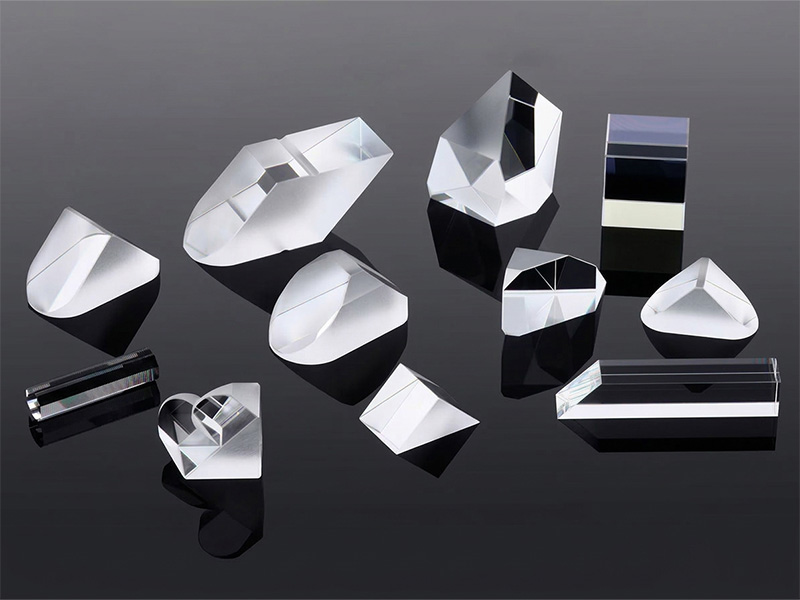
When most people think of a prism, they picture a triangular glass block splitting light into a rainbow. That image is not wrong — but it is only one member of a much larger family. Walk into an optics lab and you will find prisms shaped like pentagons, elongated trapezoids, truncated cubes, and thin wedges barely thicker than a glass slide.
What a prism looks like depends entirely on what it is designed to do. The angles, the number of faces, and even the surface coatings all change based on the optical task. Here is a quick visual guide to the shapes you are most likely to encounter.
The Basics: What Makes It a Prism
In geometry, a prism is any solid with two identical parallel bases connected by flat faces. Optical prisms follow the same rule, but the base shapes are chosen for specific reasons — a 90° angle enables total internal reflection, a 60° angle creates spectral dispersion, a five-sided cross-section locks in a precise beam deviation. The shape is never decorative. It is functional.
One thing that changes appearance dramatically: coatings. An uncoated prism looks like clear glass. Add an anti-reflection coating and the surface picks up a faint green or purple tint. Add a metallic mirror coating to one face and that face becomes opaque and reflective. The same prism design can look completely different depending on its coatings.
Common Optical Prisms by Appearance
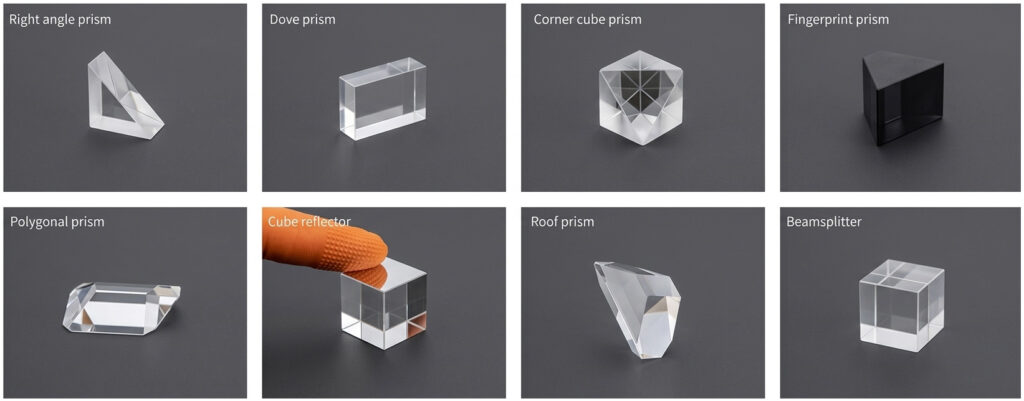
Right-Angle Prism — The closest to the textbook triangle. Cross-section is a right triangle with one 90° corner and two 45° corners. Usually small enough to hold between your fingers. If the hypotenuse is mirror-coated, one face looks opaque; if uncoated, the whole thing is transparent.
Penta Prism — Five-sided cross-section, noticeably chunky. Two faces are always mirror-coated, so part of the prism looks reflective while the entrance and exit faces stay clear. You will find these inside SLR camera viewfinders.
Dove Prism — Elongated trapezoid, wider than it is tall, with a long slanting base. If the prism in your hand is obviously longer than it is wide — and has that asymmetric profile — it is likely a dove prism. It flips images and rotates them when you spin it.
Roof Prism (Amici) — Looks like a right-angle prism at first glance, but the hypotenuse face has a sharp ridge running down the center, like a rooftop. That ridge adds an extra reflection to correct image orientation. Common in binoculars.
Corner Cube Retroreflector — Looks like someone sliced a corner off a glass cube. Three perpendicular internal faces meet at a single point. Look into it and your own eye stares back at you no matter how you tilt it. That is retroreflection.
Wedge Prism — The most subtle shape. It looks almost like a flat window, but one edge is slightly thicker than the other. The wedge angle can be less than a degree. You might not notice it until you hold the edge against a straight reference.
Equilateral (Dispersive) Prism — The Newton’s experiment shape. Three 60° angles, three equal faces. Often made from high-dispersion glass that can have a faint yellowish tint compared to standard optics. Hold it up to sunlight and you get the rainbow.
Rhomboid Prism — A glass parallelogram. The entrance and exit faces are parallel but offset, so the beam shifts sideways without changing direction. It looks like a rectangular block that got sheared to one side.
Quick Identification Tips
The fastest way to figure out what type of prism you are looking at: count the faces, check for mirror-coated surfaces, and look for any roof edge or asymmetry. A five-sided shape with two reflective faces is a penta prism. A long trapezoid is a dove prism. A triangular face on something that looks like a cut cube is a corner cube. Once you know the basic profiles, identification becomes quick.
FAQ
How is an optical prism different from a glass window?
A window has two parallel faces. A prism has faces set at deliberate angles to each other. Look at the edge — if the two largest surfaces are not parallel, it is a prism.
Why do some prisms look colored even though the glass is clear?
The color comes from thin-film coatings, not the glass itself. Anti-reflection coatings create green, purple, or blue tints in reflected light. The transmitted light stays colorless.
Can I tell the prism type from shape alone?
Usually yes. Count the faces, note any mirror coatings, check for a roof edge, and see whether the shape is symmetric or elongated. That narrows it down fast.
