

What Is Optical Window Glass?
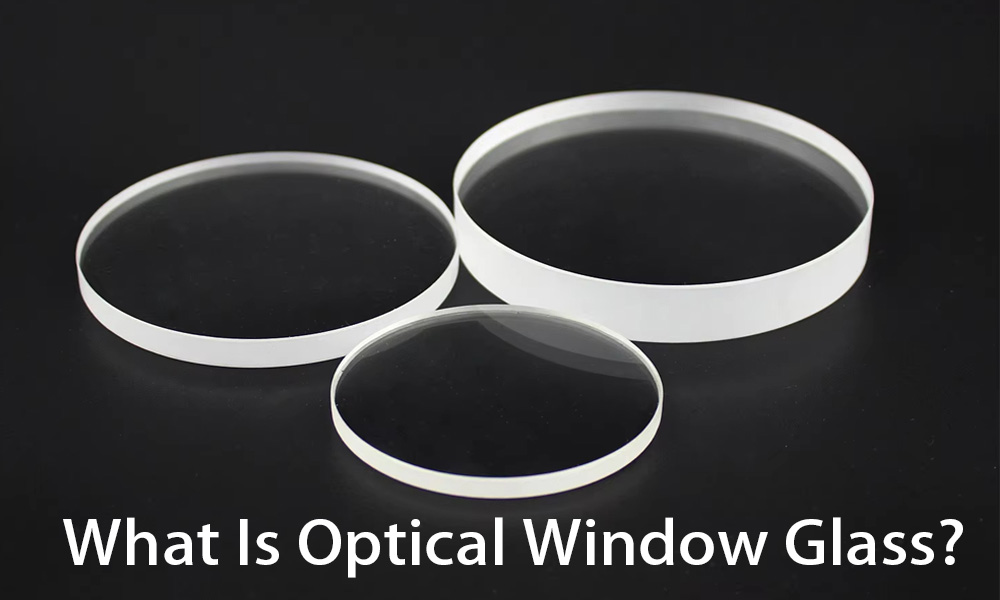
An optical window is a plane-parallel glass or crystalline substrate used to transmit a defined wavelength range while isolating an optical system from its surrounding environment. Unlike a lens, it does not introduce optical power, and unlike a filter, it is not intended to modify the spectral content within its transmission band.
In practical use, this combination of transmission and isolation imposes a set of constraints that are not typically addressed by standard commercial glass. Soda-lime glass, for example, performs adequately in the visible range but shows strong absorption in the ultraviolet below ~350 nm and in the mid-infrared beyond ~2.5 µm. Its thermal shock resistance, vacuum compatibility, and surface finish are also generally insufficient for precision optical systems. Optical window materials are therefore selected and processed to meet defined requirements in transmission, surface quality, and environmental stability.
What Makes an Optical Window Different from Ordinary Glass
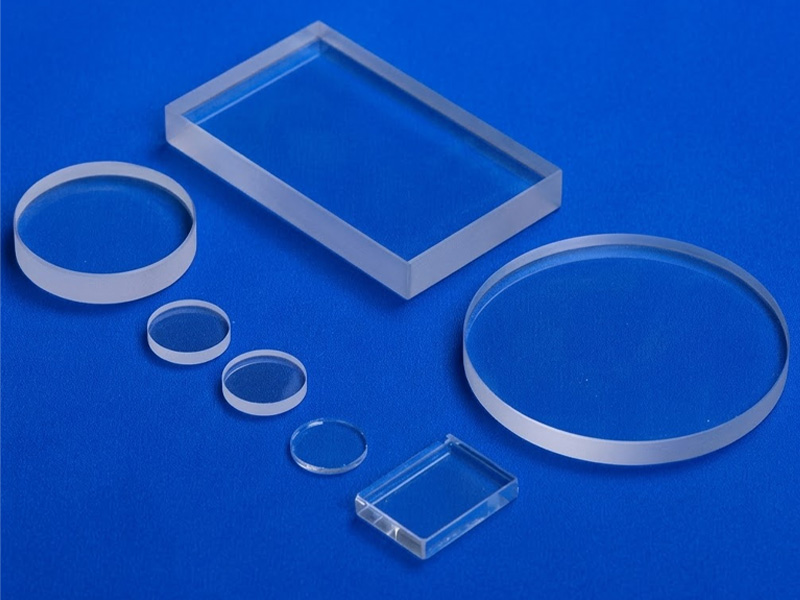
The distinction lies primarily in dimensional control and material quality. Optical windows are manufactured with both surfaces flat and parallel within specified tolerances, depending on application requirements.
Surface flatness is commonly specified in fractions of a wavelength (e.g., λ/4 to λ/10 at 632.8 nm). Parallelism is controlled to limit beam deviation, particularly in collimated or laser-based systems. Surface quality is defined using scratch-dig specifications (per MIL-PRF-13830B), with 60-40 suitable for general use and tighter specifications such as 20-10 or 10-5 applied in laser or high-resolution imaging systems.
These parameters are intended to limit wavefront distortion and scatter. Surface irregularities or wedge between the two faces can introduce angular deviation, while surface and subsurface defects contribute to scattering. The required specification level is typically determined by system sensitivity to these effects.
Key Specification Parameters and Material Selection for Optical Windows
Optical window selection begins with the required transmission wavelength, which defines the viable material class. Surface quality, thermal behavior, and coatings then refine the specification based on system constraints.
Transmission Range and Material Selection
The required wavelength band determines the material platform:
- Ultraviolet (<400 nm)
Fused silica is the default choice, transmitting down to ~185 nm with excellent homogeneity and high laser damage threshold. For deeper UV (<160 nm), calcium fluoride extends transmission, though with reduced mechanical robustness. Sapphire may be selected where mechanical durability or chemical resistance is critical. - Visible to Near-Infrared (400 nm – 2 µm)
BK7 is the standard material in this range, offering a balance of optical quality, cost, and manufacturability. Borosilicate glass provides similar spectral coverage with improved thermal shock resistance. Fused silica covers the same band with lower CTE and superior stability, making it suitable for precision and laser applications. - Mid-Infrared (2 – 14 µm)
In the mid-infrared region, material selection becomes application-specific, balancing transmission range, refractive index, and environmental limitations:- Silicon: ~1.2–7 µm, good mechanical strength and relatively low density
- Germanium: 2–14 µm, high refractive index (~4.0), widely used in thermal imaging but limited above ~100 °C
- Zinc selenide: 0.6–21 µm, standard material for CO₂ laser systems (10.6 µm)
- Calcium fluoride: up to ~8 µm, offering broad spectral versatility
Surface Quality
Surface quality is specified using scratch-dig standards, which directly affect scattering and imaging performance:
- 60-40: suitable for general optical and industrial applications
- 20-10 to 10-5: required for precision imaging and laser systems
Tighter specifications increase fabrication cost and should be selected based on actual system sensitivity rather than defaulting to the highest grade.
Thermal Performance
Thermal behavior is governed by the coefficient of thermal expansion (CTE) and maximum operating temperature:
- Fused silica: extremely low CTE (~0.55 × 10⁻⁶/°C), excellent thermal stability and thermal shock resistance
- BK7: higher CTE (~7.1 × 10⁻⁶/°C), suitable for stable environments
- Sapphire: capable of continuous operation above 1000 °C with outstanding mechanical strength
- Germanium: infrared transmission degrades above ~100 °C due to increased free-carrier absorption
Anti-Reflection Coating
Uncoated glass-air interfaces reflect approximately 4% of incident light per surface (~8% total loss for a two-surface window). Anti-reflection (AR) coatings significantly improve transmission:
- Single-layer MgF₂: reduces reflectance to ~1.5% per surface
- Multilayer broadband AR coatings: achieve <0.5% per surface over a defined wavelength range
AR coatings are typically specified wherever transmission efficiency, stray light suppression, or back-reflection control is critical.
For most precision optical systems, AR coating is a standard requirement to minimize loss and stray reflections.
Conclusion
An optical window functions as a transmissive barrier between an optical system and its environment. Its performance depends on the selection of material, surface specification, and coating, all of which should be matched to the operating wavelength and environmental conditions. When properly specified, an optical window maintains transmission efficiency, limits wavefront distortion, and remains stable over the intended service life.
