
Cylindrical Lens vs Spherical Lens: Key Differences and Applications
Introduction
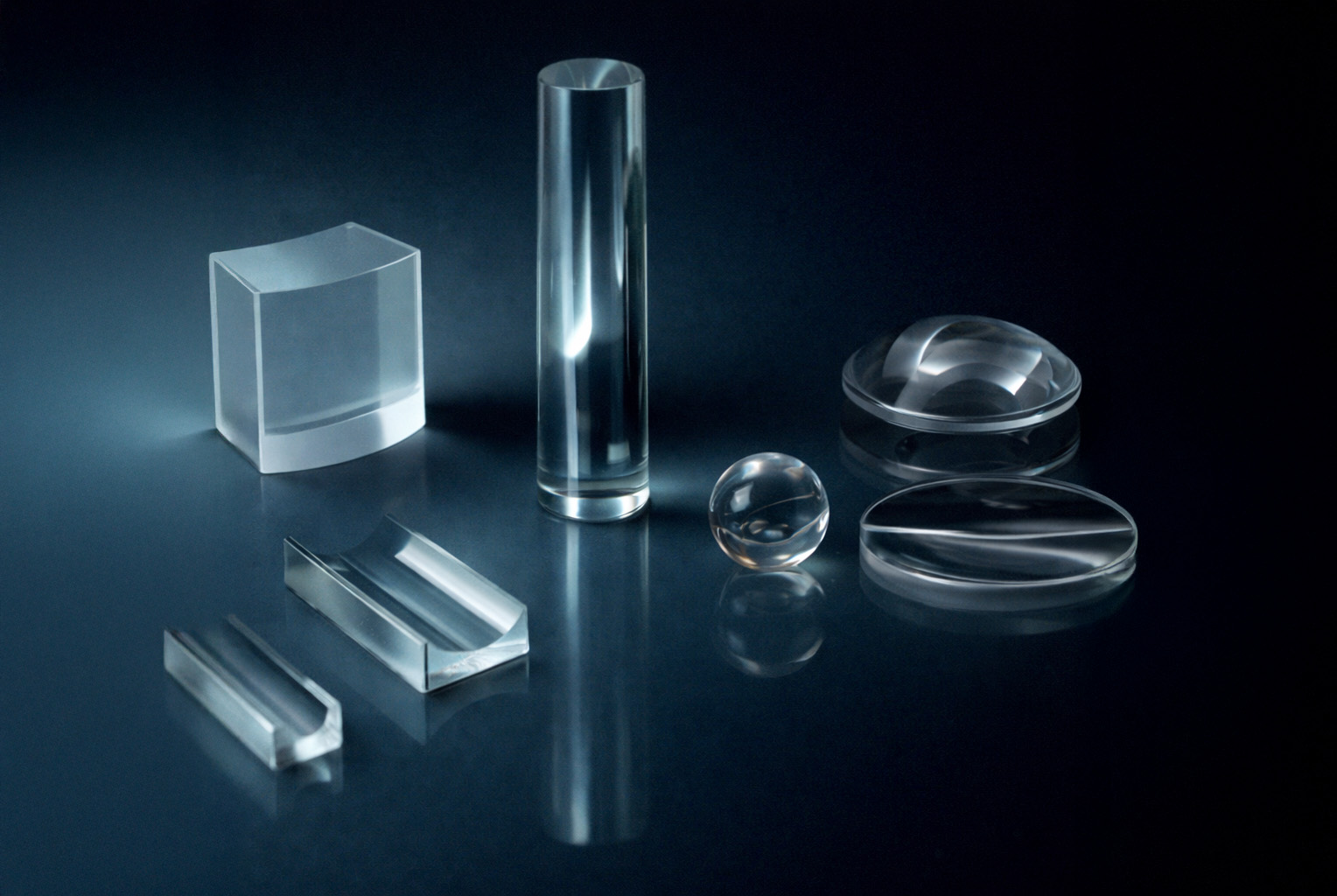
When selecting optical components for imaging, laser, or vision correction systems, the choice between a cylindrical lens and a spherical lens can significantly affect performance and functionality. While both lens types are foundational in optics, they serve fundamentally different purposes. This guide breaks down the key differences between cylindrical and spherical lenses, covering their optical properties, design characteristics, and real-world applications — so you can make the right choice for your specific use case.
What Is a Spherical Lens?
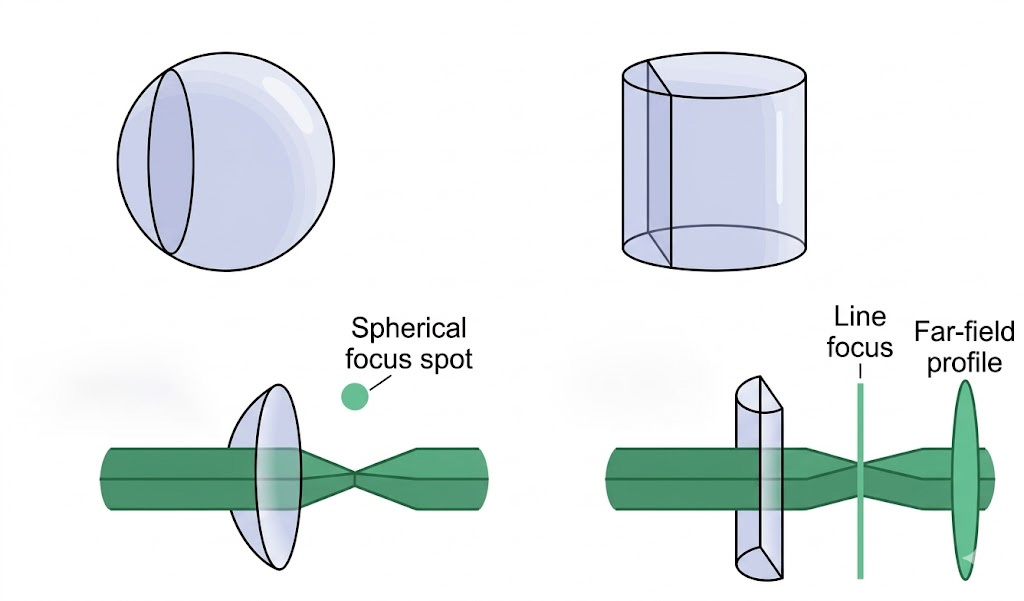
A spherical lens has a uniform radius of curvature across its entire surface, meaning its shape is derived from a sphere. This consistent curvature allows the lens to converge or diverge light equally in all directions, bringing incoming rays to a single focal point.
Spherical lenses are among the most widely used optical components. You’ll find them in camera lenses, telescopes, microscopes, and corrective eyewear. Because they focus light symmetrically, they are well suited for applications that require full-field imaging — where the goal is to produce a sharp, point-focused image of a two-dimensional scene.
One important consideration with spherical lenses is spherical aberration. When parallel rays strike the outer edges of a spherical lens, they focus at a slightly different point than rays passing through the center. High-quality spherical lenses are designed to minimize this effect, either through precise curvature grinding or by pairing multiple lens elements to compensate.
What Is a Cylindrical Lens?
A cylindrical lens has curvature along only one axis. Rather than deriving its shape from a sphere, it is shaped like a section of a cylinder — curved in one direction and flat in the other. As a result, it focuses incoming light into a line rather than a point.
This one-dimensional focusing behavior makes cylindrical lenses indispensable in applications where light needs to be shaped, compressed, or expanded along a single axis. They are widely used in laser optics, spectroscopy, barcode scanning systems, and ophthalmic instruments. In vision correction, cylindrical lenses are the standard solution for astigmatism — a condition caused by an irregular curvature in the cornea or lens that produces blurred or distorted vision. By compensating for that irregular curvature along one specific meridian, a cylindrical lens restores clear, sharp vision.
Cylindrical Lens vs Spherical Lens: Key Differences
Focal Geometry
The most fundamental difference lies in how each lens focuses light. A spherical lens produces a point focus, concentrating light to a single spot. A cylindrical lens produces a line focus, concentrating light along one axis while leaving the perpendicular axis unchanged. This distinction determines which lens is appropriate for a given optical system.
Optical Applications
Spherical lenses are the standard choice for applications requiring full two-dimensional imaging — landscape photography, wide-angle imaging systems, and general-purpose microscopy all rely on the symmetric focusing of spherical optics. Cylindrical lenses, by contrast, excel wherever precise linear focusing is required: laser beam shaping, barcode scanners, slit illumination systems, and multi-focal plane simultaneous imaging are all typical use cases.
Correction Capability
Both lens types can correct optical errors, but they address different problems. Spherical lenses correct for defocus and spherical aberration across a rotationally symmetric optical path. Cylindrical lenses correct for astigmatism, compensating for curvature differences along one axis to restore image sharpness in that specific direction.
Manufacturing Complexity and Cost
Spherical lenses are geometrically simpler to manufacture. Their rotationally symmetric surfaces can be ground and polished using established, highly automated techniques, making them more cost-effective to produce at scale. Cylindrical lenses require careful control of curvature, asymmetry, and axis orientation throughout fabrication. This additional complexity makes them more demanding to manufacture and generally higher in unit cost compared to spherical lenses of similar aperture and quality.
Choosing the Right Lens for Your Application
The decision between a cylindrical and a spherical lens comes down to the geometry of your optical system and what you need light to do.
If your system requires symmetric, point-focused imaging — whether for a camera, a telescope, or a microscope — a spherical lens is the natural choice. Its uniform curvature handles full-field scenes efficiently and cost-effectively.
If your application involves shaping a laser beam, correcting astigmatism, or focusing light along a single axis, a cylindrical lens is the appropriate solution. Its asymmetric curvature gives you precise control over one dimension of the light path without affecting the other.
In some advanced optical systems, cylindrical and spherical lenses are used together. A cylindrical lens may handle beam shaping along one axis, while a spherical lens manages overall focusing — a combination commonly seen in laser diode collimation and line-scan imaging systems.
Conclusion
Cylindrical lenses and spherical lenses each occupy a distinct role in optical design. Spherical lenses offer symmetric, point-focused imaging suited for broad photographic and scientific applications. Cylindrical lenses provide one-dimensional focusing precision that is essential in laser systems, astigmatism correction, and linear beam shaping. Understanding the optical behavior and design requirements of each type is the first step toward building systems that perform reliably and efficiently.
At Star Optics, we supply both cylindrical and spherical lenses to specification, with options across a range of substrate materials, coatings, and surface quality grades. Contact us to discuss your application requirements.
