Anti-Reflective Coating
We provide custom anti-reflective coating solutions for optical glass, supporting everything from coating design to stable production with consistent optical performance.
Anti-Reflective Coating One-stop Solution
Star Optics delivers precision-engineered anti-reflective coatings optimized for high-performance optical glass components. Leveraging multiple thin-film deposition technologies—including magnetron sputtering, ion-assisted e-beam deposition, and thermal evaporation—we customize each coating to meet application-specific spectral, mechanical, and environmental requirements. Our processes ensure high durability, stable optical performance, and uniformity across apertures from small optics to large-format glass panels.
Our Glass AR Coating Capability
As a dedicated custom optical coatings manufacturer, we develop tailored custom AR coating service solutions for:

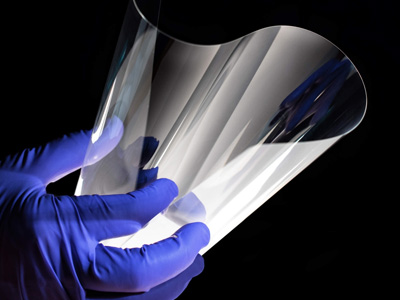
AR Coating for Ultra-Thin Glass (≤0.1 mm)
Optimized for ultra-thin glass substrates from 30–100 μm, delivering low reflectance and high transmission while maintaining mechanical stability for flexible and compact optical systems.
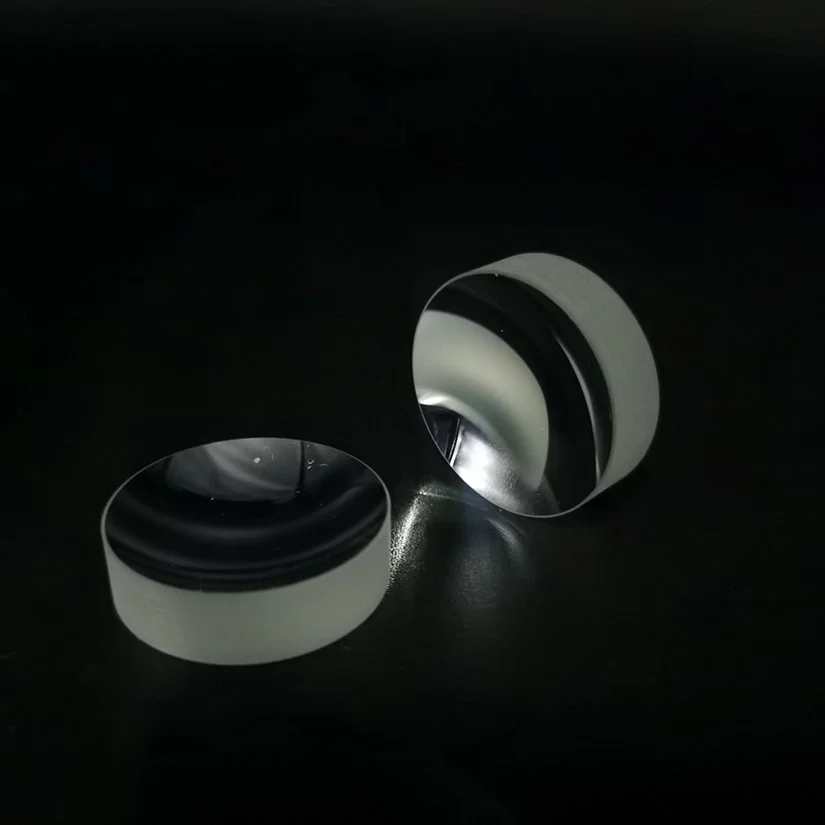
Visible 400–700 nm Broadband AR Coating
Multi-layer broadband AR coating designed to minimize reflection across the visible spectrum, suitable for imaging, display, and general optical applications.
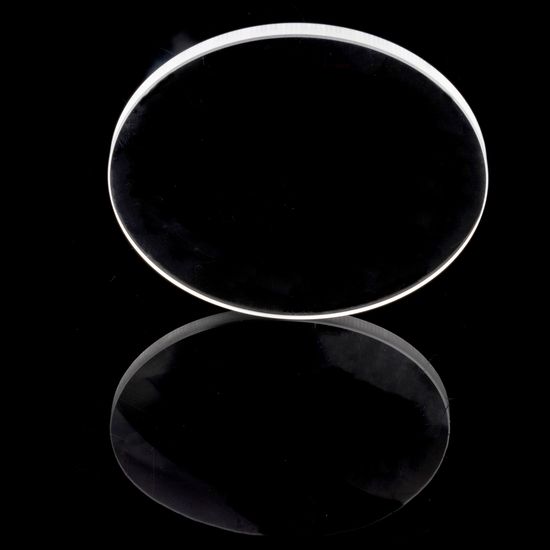
AR Coating for Optical Windows & Substrates
AR coatings applied to flat optical windows and glass substrates, providing uniform performance and excellent environmental stability.
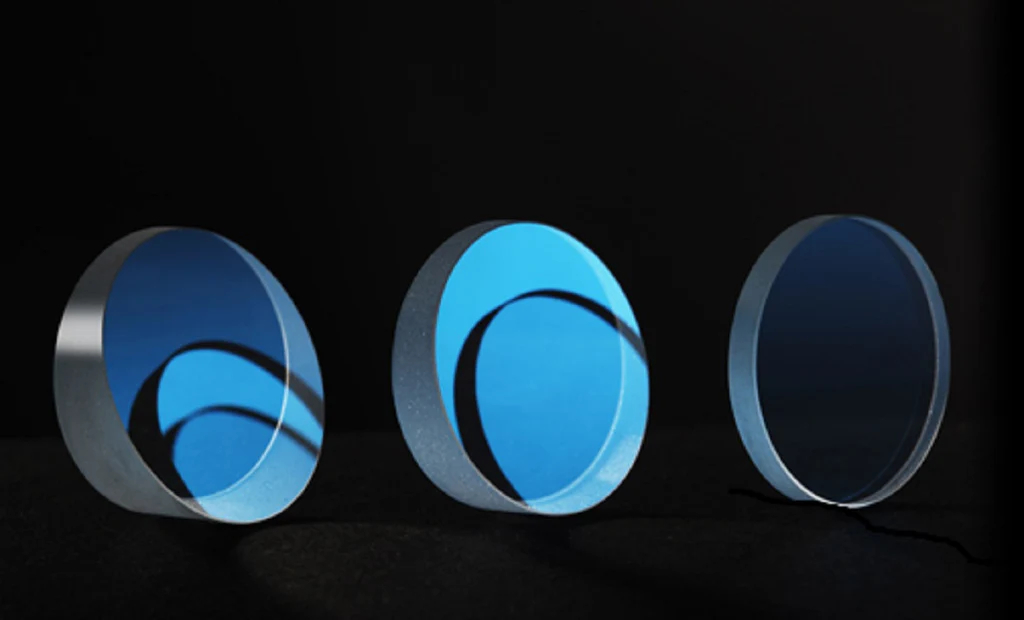
UV AR Coating (193–400 nm, Deep UV)
Precision AR coatings for UV and deep-UV optics, offering high transmission and low reflectance for lithography, spectroscopy, and UV sensing applications.
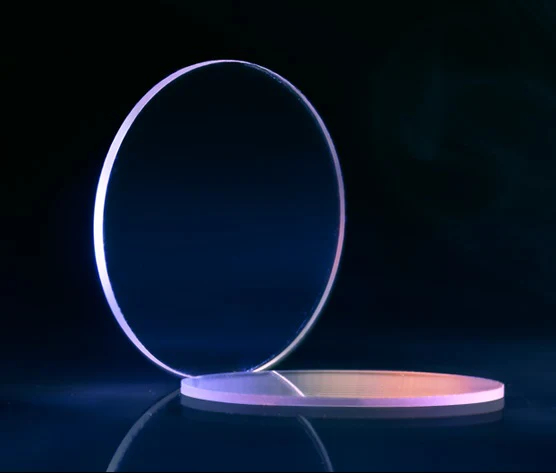
Dual-Band / Multi-Band AR Coating
Custom AR coatings designed for dual or multiple wavelength bands, supporting complex optical systems that operate across separated spectral regions.
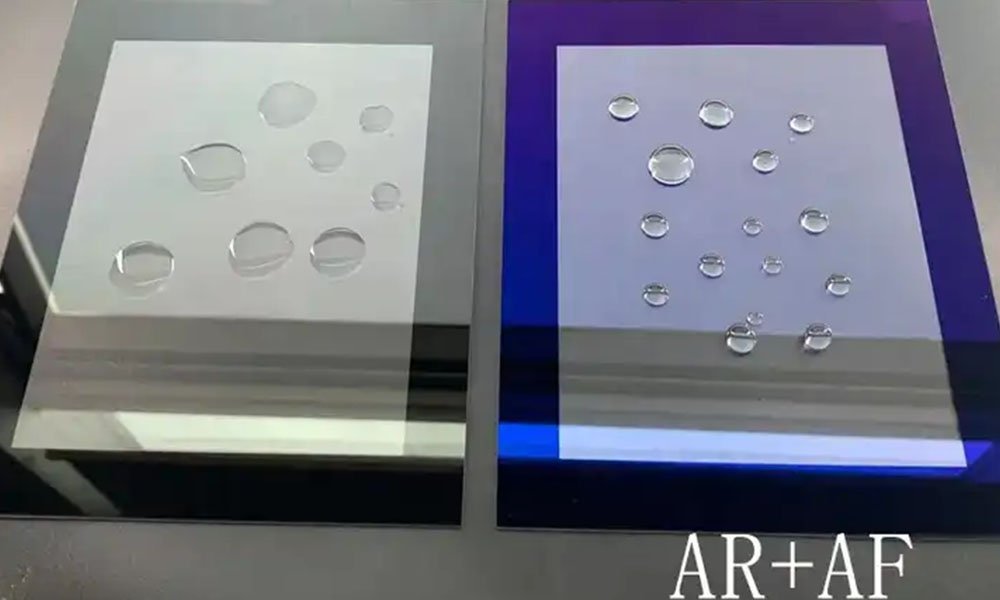
Anti-Fingerprint / Anti-Smudge AR Coating (AR + AF)
Combines anti-reflective performance with oleophobic surface treatment, improving cleanliness, durability, and user experience for touch-facing optics.
Understanding AR (Anti-Reflective) Coating Technology
How AR Coating Works
When light hits an uncoated optical surface, approximately 4-5% reflects at each air-glass interface, resulting in significant optical losses. AR coatings work by:
- Destructive Interference – Multiple thin film layers are engineered so that reflected light waves cancel each other out
- Refractive Index Matching – Each layer is designed with specific optical properties to minimize impedance mismatch
- Wavelength Optimization – Coating thickness and materials are precisely calculated for target wavelength performance
This technology allows optical systems to achieve 99%+ light transmission efficiency, dramatically improving image quality, brightness, and overall system performance.
Why Choose Star Optics for AR Coatings?
Comprehensive Glass Substrates
We specialize in AR coatings for a full range of optical and industrial glass materials, including:
BK7 and other borosilicate crown glasses
Soda-lime glass , consumer, and display applications
Fused silica and quartz glass
Aluminosilicate and high-strength cover glass
Ultra-thin glass (≤0.1 mm)
Custom optical glass compositions and specialty materials
High-Performance AR Coating Capabilities
Reflection levels <0.1% achievable over targeted wavelengths
UV–VIS–NIR coverage from 193 nm to 2.5 μm; extended options up to mid-IR
Designed for angles of incidence up to 50°
Available in single-layer, V-coat, dual-band, and broadband designs
High-durability options including DLC, hard-oxide stacks, and scratch-resistant coatings
Environmental stability validated through temperature cycling, humidity, and adhesion testing
Quality-Driven Manufacturing
Star-Optics operates a vertically integrated workflow combining optical polishing, thin-film deposition, and metrology. Every AR coating is validated using high-accuracy spectrophotometers and environmental reliability testing. Our quality system supports demanding industries such as precision optics, imaging, biomedical devices, sensors, laser systems, and advanced display technologies.
Custom Engineering Support
Our engineering team collaborates directly with OEM and R&D customers to develop optimized AR coating stacks for specific wavelengths, system geometries, and environmental constraints. From quick-turn prototypes to stable volume production, we provide technical design files, testing reports, and consistent lead times of 3–5 weeks for most glass-based AR coating projects.
| Technical Data of AR Coating | |||
|---|---|---|---|
| Coating Types | Standard AR, UV AR, NIR AR, Laser-Grade AR, Broadband AR, Multi-Wavelength AR, High-Energy Laser AR, Dispersion-Optimized AR | Surface Reflectance | <0.5% per surface (standard visible AR) |
| Wavelength Range | 200–2500 nm (customized ranges available) | Thickness Range | 0.2–20 mm (depending on substrate) |
| Applicable Materials | Optical glass, fused silica, BK7, sapphire, quartz | Surface Hardness | 5–7H |
| Transmittance | Up to 99% (typical: >97–99% depending on coating type) | Weather Resistance | Long-term stability; lifespan over 25 years under normal conditions |
| Color Reproducibility | Close to 99% | ||
Partner with a Leading Precision Optics Supplier
Contact Star-Optics today to discuss your custom AR coating service requirements. Let us help you optimize light transmission, reduce optical losses, and enhance the performance of your optical components through our advanced optical thin film technology and proven OEM/ODM optical coating services.
Anti-reflective Coating FAQS
What is an Anti-Reflective (AR) coating?
An AR coating is a multi-layer thin film applied to optical surfaces to reduce reflection and improve transmission. By precisely controlling refractive indices and layer thicknesses, AR coatings minimize optical losses at specific wavelengths or across broad spectral ranges.
What is the difference between broadband AR and V-coat AR?
Broadband AR: Low reflection across a wide spectral band.
V-coat AR: Extremely low reflection at a specific wavelength (e.g., 325 nm, 532 nm, 850 nm, 1550 nm).
Broadband is ideal for imaging; V-coat is ideal for lasers and monochromatic systems.
Can you coat both sides of a substrate?
Yes. Most AR applications require double-side coating, and we ensure precise alignment and uniformity on both surfaces.
Can you provide coating performance testing?
Yes. We supply:
Spectral transmission curves
Reflectance data
Environmental durability results
Coating thickness measurements
Surface quality inspection
Complete optical reporting can be provided for regulated or mission-critical projects.
Do you design custom AR stacks for OEM production?
Absolutely. We offer full custom stack design, simulation, prototyping, and volume manufacturing support, including documentation and batch consistency control.