

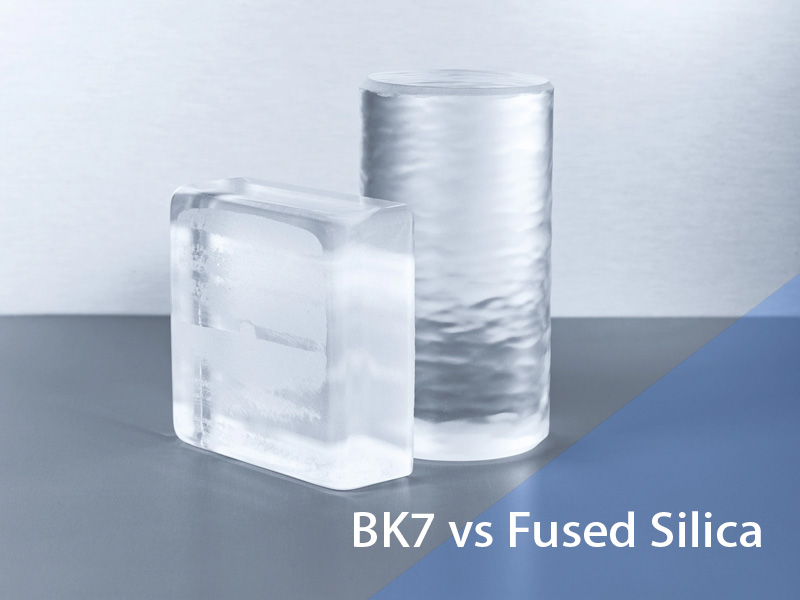
BK7 vs Fused Silica: How to Choose the Right Optical Glass
If you work with optical components — lenses, prisms, windows, or mirror substrates — the first material decision you face is almost always this one: BK7 or fused silica? These two glasses dominate the optics industry for good reason. Both offer excellent clarity, low bubble content, and reliable performance. But they are not interchangeable. Picking the wrong one can mean poor UV transmission, thermal instability, or unnecessary cost.
Here are the key differences that matter when you are choosing between them.
| Property | BK7 | Fused Silica |
|---|---|---|
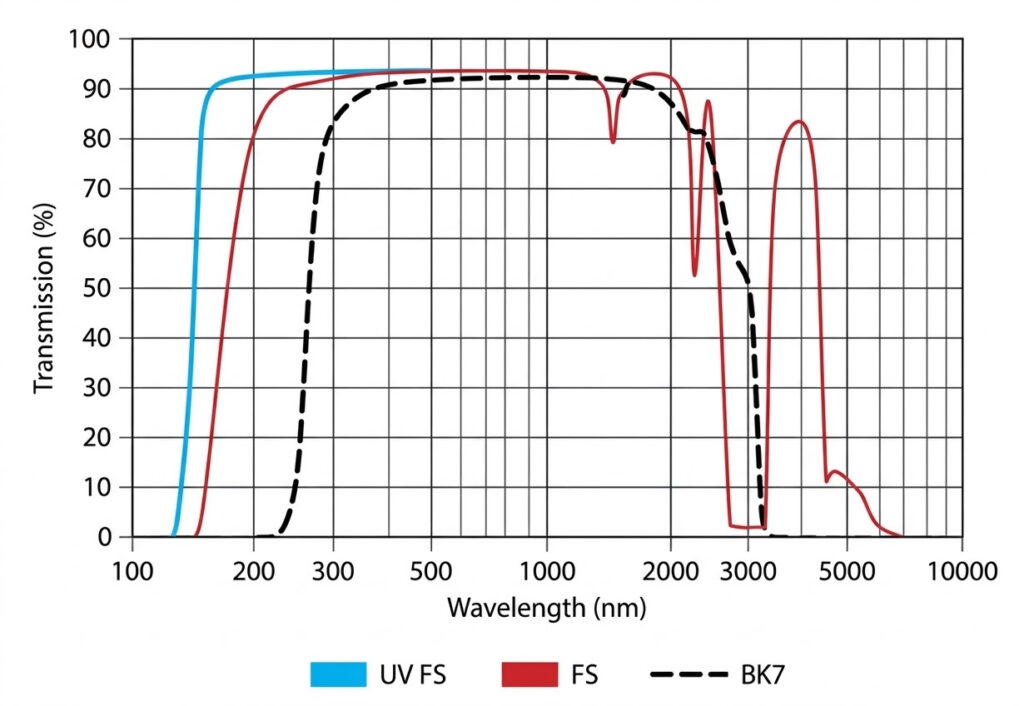
| Transmission | 380–2100 nm | 195–2100 nm |
| Refractive Index | 1.5168 | 1.4585 |
| Thermal Expansion | 7.1 ×10⁻⁶ | 0.55 ×10⁻⁶ |
| Laser Damage | Moderate | High |
| Cost | Lower | Higher |
1. What They Are
BK7 is a borosilicate crown glass — one of the most widely used optical glasses in the world. It contains silicon dioxide mixed with boron oxide and small amounts of other compounds. This composition makes it easy to melt, shape, and polish. The designation “N-BK7” refers to the lead- and arsenic-free version made by Schott, though the optical properties are nearly identical to classic BK7. Other manufacturers produce equivalents under different names (H-K9L from CDGM is the most common).
Fused silica is pure silicon dioxide — no additives, no mixed oxides. UV-grade synthetic fused silica is made by flame hydrolysis of silicon tetrachloride, which produces an extremely high-purity amorphous glass. Because there is only one chemical component, its behavior is simpler and more predictable under stress, heat, and UV exposure.
| Property | BK7 (N-BK7) | UV-Grade Fused Silica |
|---|---|---|
| Useful Transmission Range | 380–2,100 nm | 195–2,100 nm |
| Refractive Index (at 587.6 nm) | 1.5168 | 1.4585 |
| Abbe Number | 64.17 | 67.82 |
In the visible range, both materials look identical to the naked eye — colorless and highly transparent. The difference only shows up when you send UV light through them.
3. Thermal Properties
Fused silica has an extremely low coefficient of thermal expansion — about 0.55 × 10⁻⁶/°C. BK7’s thermal expansion is roughly 7.1 × 10⁻⁶/°C, which is more than twelve times higher.
What does this mean in practice? If your optical component experiences temperature changes — from ambient shifts, laser heating, or outdoor deployment — fused silica holds its shape far better. Dimensions stay stable. The refractive index drifts less. For precision mirror substrates, interferometer flats, and laser cavity optics, this thermal stability is often the deciding factor.
BK7 is adequate for most room-temperature applications where thermal loads are modest. But for anything involving high-power lasers or environments with significant temperature swings, fused silica is the safer choice.
| Thermal Property | BK7 | Fused Silica |
|---|---|---|
| Thermal Expansion (×10⁻⁶/°C) | 7.1 | 0.55 |
| Laser Damage Threshold | Moderate | High |
| Recommended for Precision Mirrors | No | Yes |
4. Mechanical and Chemical Durability
BK7 is a hard glass with good scratch resistance. It polishes well and holds up in normal laboratory and industrial environments. Chemically, it passes all standard resistance tests — humidity, acid, alkali — without special handling.
Fused silica is also hard and chemically stable, but it is more difficult to manufacture. The melting point exceeds 1,600°C, and maintaining the purity needed for optical-grade material adds complexity. This is reflected in the price.
One area where fused silica has a clear edge: surface quality after polishing. BK7 tends to be slightly softer and can develop subtle defects during polishing that only become visible after cleaning. Fused silica generally achieves a more stable, consistent surface finish — which matters for high-precision or high-power applications.
5. Cost
BK7 is significantly less expensive than fused silica. The raw material costs less, the melting temperature is lower, and it is easier to work with during grinding, polishing, and shaping. For visible-range optics where UV transmission and thermal stability are not critical, BK7 offers excellent performance per dollar.
Fused silica costs more at every stage — raw material, manufacturing, and finishing. The premium is justified when you need UV capability, low thermal expansion, or high laser damage threshold. But if your application does not require any of those, choosing fused silica over BK7 adds cost without adding value.
When to Use Each
Choose BK7 when:
- Your wavelength range is within the visible and near-IR (above 380 nm)
- The component operates at stable room temperature
- Budget is a priority
- You are making lenses, prisms, or windows for imaging, cameras, or general laboratory use
Choose fused silica when:
- You need UV transmission below 350 nm
- The component will be exposed to high-power laser energy
- Thermal stability is critical (precision mirrors, interferometry, outdoor optics)
- Surface quality requirements are especially demanding
For many projects, the decision is straightforward. If you are working in the visible range at room temperature, BK7 does the job at lower cost. The moment UV light, laser power, or thermal stress enters the picture, fused silica becomes the right material.
FAQ
Can I use BK7 for UV applications?
BK7 works down to about 350 nm, but transmission drops rapidly below that. For deep UV work (below 300 nm), you need fused silica or a crystal material like CaF2.
Is N-BK7 different from BK7?
N-BK7 is the lead- and arsenic-free version of BK7. The optical properties are nearly identical. Most manufacturers now supply N-BK7 by default.
Why is fused silica more expensive?
The raw material requires extremely high purity, and the melting point exceeds 1,600°C. Both factors add manufacturing cost compared to borosilicate glasses like BK7, which melt below 600°C.
Which material is better for laser optics?
Fused silica, in most cases. It has a higher laser damage threshold, lower absorption, and lower thermal expansion — all of which matter when the optic is exposed to intense laser energy.
Can I tell BK7 and fused silica apart by looking at them?
In the visible range, both appear colorless and transparent. You cannot reliably distinguish them by eye. The difference becomes apparent in UV transmission measurements or by checking the refractive index.
If you’re selecting materials for optical lenses, prisms, or precision windows, choosing the right substrate is critical. Our engineering team can help evaluate whether BK7 or fused silica best fits your optical system.
