
GLASS CUTTING
With multiple cutting technologies available in-house, we provide an optimal cutting solution based on glass type, thickness, and end-use requirements—ensuring performance, yield, and cost efficiency for OEM and industrial customers.
Precision Glass Cutting Processes
Star-optics specializes in custom glass cutting for a wide range of industrial applications, including optics, electronics, and specialized manufacturing. By integrating CNC machining, laser cutting, and water jet cutting with disciplined process control, we deliver stable, production-grade results across quartz glass, high borosilicate glass, soda-lime glass, aluminosilicate glass, and other optical glass substrates. Our workflow supports both standard profiles and complex, custom geometries while maintaining consistent dimensional accuracy and clean edge quality. Every component is produced to your specified tolerances and downstream processing needs, ensuring predictable performance from prototyping to high-volume production.
To get started, simply provide your design file (DXF, DWG, STEP, STL, PDF, and other common formats are accepted). You’ll receive a prompt quote and complimentary manufacturability feedback—typically within 24 hours. All submissions are handled with strict confidentiality to protect your intellectual property.
Our CNC cutting service is designed for precision and flexibility, capable of handling a wide range of glass materials and thicknesses. With our CNC machines, we can cut glass into various shapes and sizes, from standard straight-line cuts to more complex geometries. We use a combination of high-quality tools and advanced positioning systems to ensure consistent results.
Materials: Optical Glass, Ceramics, Borosilicate, Sapphire
Thickness Range: 0.7mm to 15mm
Tolerance: ±0.05mm
Applications: Optical components, custom glass shapes, and precision lenses
CNC cutting is well-suited for both high-volume production and smaller, custom orders, ensuring precise cuts that meet specific design requirements.
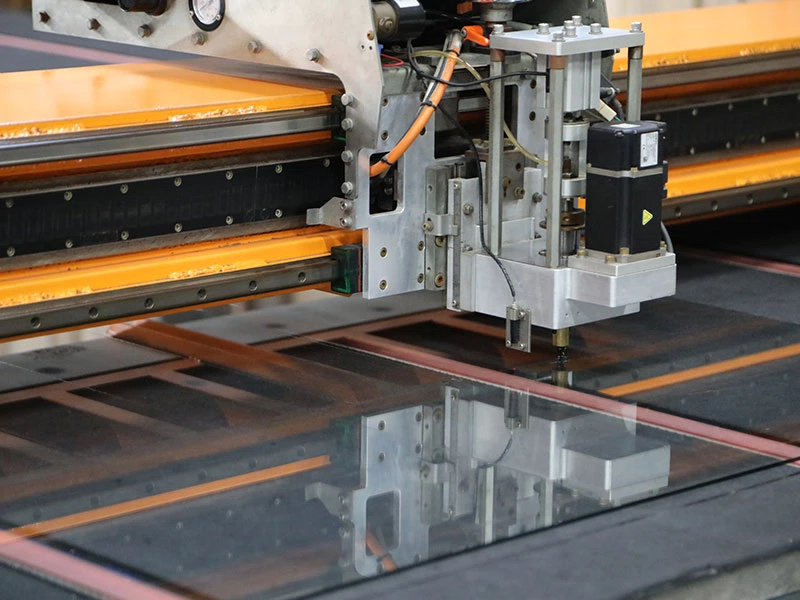
CNC Cutting

Water Jet Cutting
Water jet cutting is a versatile solution for cutting thicker glass and intricate designs. Using a high-pressure water stream, often mixed with an abrasive material, this method delivers precise cuts while avoiding heat damage to the glass. It’s an ideal choice for complex shapes and designs that need to be cut with minimal kerf.
Materials: Optical Glass, Ceramics, Borosilicate, Quartz
Thickness Range: 10mm to 30mm
Tolerance: ±0.1mm
Applications: Large custom shapes, intricate patterns, and thick glass components
Water jet cutting is well-suited for applications that require flexibility and high accuracy, such as cutting glass components for electronics or industrial uses.
Laser cutting offers precise, clean edges with minimal post-processing. This method is ideal for producing intricate shapes and fine details, especially in thinner glass materials. The non-contact nature of the laser ensures no mechanical stress on the material, which helps maintain the structural integrity of the glass.
Materials: Optical Glass, Quartz, Borosilicate
Thickness Range: 0.1mm to 10mm
Tolerance: ±0.1mm
Applications: Lenses, mirrors, and custom glass components
Laser cutting is particularly useful for high-precision applications that require smooth, sharp edges and fine details, especially when working with thin, delicate glass.

Laser Cutting
FAQS
Can you cut complex shapes or micro-features?
Yes. We support straight cuts, curves, internal cutouts, slots, micro-channels, chamfers, and irregular profiles. Complex geometries are evaluated based on material fragility and minimum feature size.
Can you provide edge finishing after cutting?
Yes. Available options include raw cut edge, fine-grind edge, polished edge, and chamfered edge. We match the finish to mechanical, optical, or assembly requirements.
What dimensional tolerances can you achieve?
Most projects fall within ±0.05-0.08 mm, and tighter tolerances may be achievable depending on part size, material, and cutting method. We review tolerance feasibility during DFM feedback.
The Advantages of Laser Cutting for Optical Glass
Laser cutting provides significant advantages when processing optical glass, particularly where precision, edge quality, and geometric flexibility are critical. Unlike mechanical scoring or traditional diamond cutting, the laser is a non-contact tool that minimizes micro-cracks, chipping, and mechanical stress on brittle substrates. This enables the production of fine features, tight radii, and complex outlines with high repeatability. The localized heat input also reduces the need for extensive post-polishing, helping accelerate prototyping cycles and lower overall fabrication costs.