
Optical Coating
we provide custom optical coating services integrated with precision glass fabrication. By combining material expertise, advanced deposition processes, and strict quality control, we deliver reliable coating solutions for demanding industrial, scientific, and OEM applications
Optical Coating Services for Precision Optical Components
An optical coating is a carefully engineered stack of dielectric or metallic thin films applied to an optical substrate. By tailoring layer thickness, refractive index, and deposition conditions, coatings can minimize surface reflections, enhance reflectivity at specific wavelengths, or selectively transmit defined spectral bands.
Optical coating performance is closely linked to substrate quality, surface finish, and environmental requirements. For this reason, coating design must always be considered as part of the overall optical component engineering process.
Our Optical Coating Capabilities
Reflectivity Performance
Reflectance can be controlled from approximately 0.2% to 99.5%, depending on coating design and wavelength requirements.
Wavelength Range
Optical coatings are available from 193 nm to 14 μm, covering UV, visible, mid-IR, and far-IR applications.
Coating Size Capability
We support coating of optical components from 5 mm up to 1,000 mm in size, suitable for both precision optics and large-area components.
Coating Materials
Thin-film coatings use common oxide and fluoride materials such as MgF₂, SiO₂, Ta₂O₅, and HfO₂, as well as selected metal layers for mirror coatings.
Coating Types Supported
Our coating capabilities include, but are not limited to:
Anti-reflection (AR) coating
sBroadband and multi-band AR coatings
High-reflection (HR) dielectric coatings
Metallic mirror coatings (Aluminum, Silver, Gold)
Partial reflectors and dichroic coatings
Non-polarizing and limited polarization separation coatings
Bandpass coatings for UV, visible, and IR
Beamsplitter coatings
Neutral density (ND) coatings
Quality Control & Test Standards
Coatings are tested according to MIL-F-48616, MIL-C-675C, MIL-STD-810G, and relevant ISO 9211 / ISO 9022 standards to ensure optical performance and reliability.
4 Different Coating Technologies We Applied
To meet different optical performance, durability, and cost requirements, we apply multiple thin-film deposition technologies in production. Each process is selected based on coating density, wavelength accuracy, environmental stability, and laser damage threshold requirements.
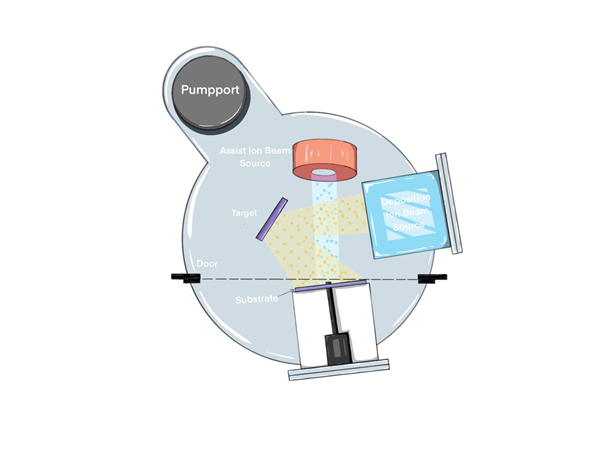
Ion Beam Sputtering (IBS)
A premium coating process producing extremely dense and smooth films with precise thickness control, low optical scatter, and excellent laser damage resistance.

Advanced Plasma Sputtering (APS)
Combines advanced plasma control and automated process optimization to produce smooth, dense, and highly uniform optical coatings with excellent repeatability. APS is well suited for multilayer coatings requiring tight spectral tolerances, high production consistency, and scalable volume manufacturing.

Ion-Assisted Electron Beam (IAD E-Beam) Deposition
A cost-effective solution for high-quality optical coatings, delivering improved film density, strong adhesion, and stable optical performance for a wide range of AR and mirror coatings.

Plasma-Assisted Reactive Magnetron Sputtering (PARMS)
Ideal for hard, durable dielectric coatings and optical filters that require long-term environmental stability and consistent spectral performance.

Custom Optical Coatings
Optimal coating design depends on multiple factors, including the target wavelength range, angle of incidence, operating environment, and overall project budget. Backed by extensive experience in advanced coating technologies, our engineering team works closely with customers to develop custom optical coating solutions that are precisely tailored to their application requirements.
FAQS
What wavelength ranges can you coat?
We provide coatings covering ultraviolet, visible, near-infrared, and infrared spectral regions, depending on coating design and substrate compatibility.
Do you offer custom coating designs?
All coatings can be custom-designed to meet specific optical, mechanical, and environmental requirements. Designs are optimized for both performance and manufacturability.
What substrates can be coated?
We coat a wide range of substrates including optical glass, fused silica, quartz, crystalline materials, and selected infrared materials such as ZnSe and germanium.
What factors determine the optical performance of a dielectric coating?
Optical performance is governed by the refractive indices of the coating materials, individual layer thicknesses, total layer count, and coating stack design. These parameters collectively define interference behavior, spectral response, angular sensitivity, and polarization dependence.
What tolerances are typical for precision optical coatings?
Typical tolerances include spectral shift within ±1–2% of the design wavelength and reflectance or transmittance variation within defined application limits. Tighter tolerances can be achieved depending on design complexity and production volume.