
Bi-Concave Lenses
- Home
- portfolio
- Spherical Lenses
- Bi-Concave Lenses
Bi-Concave Lens Product Overview
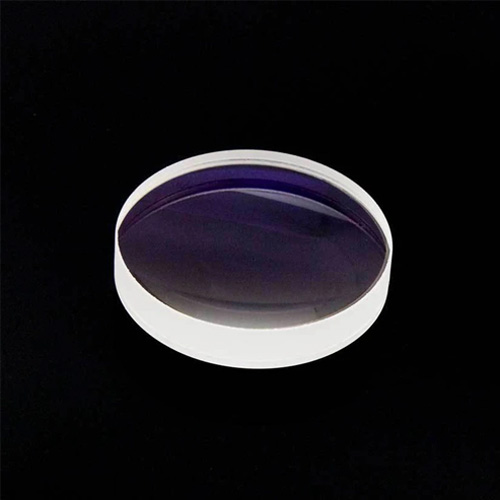
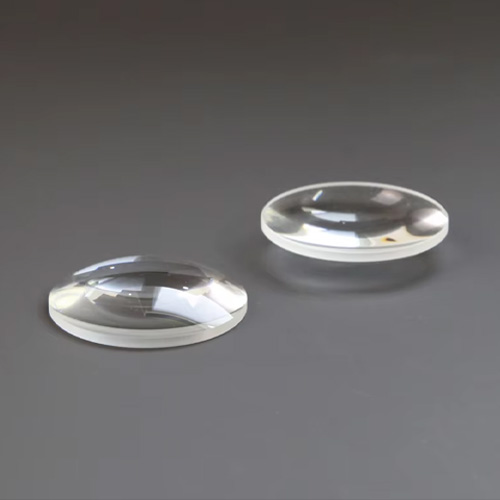
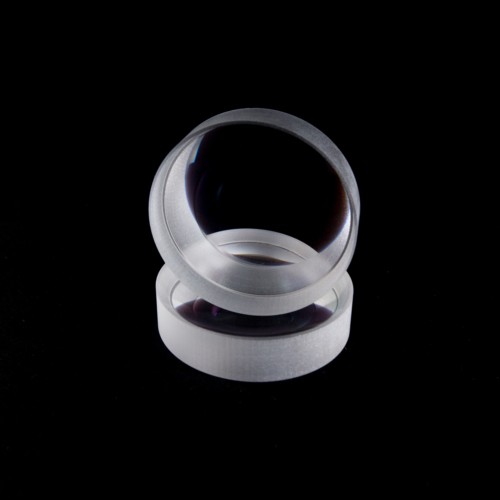
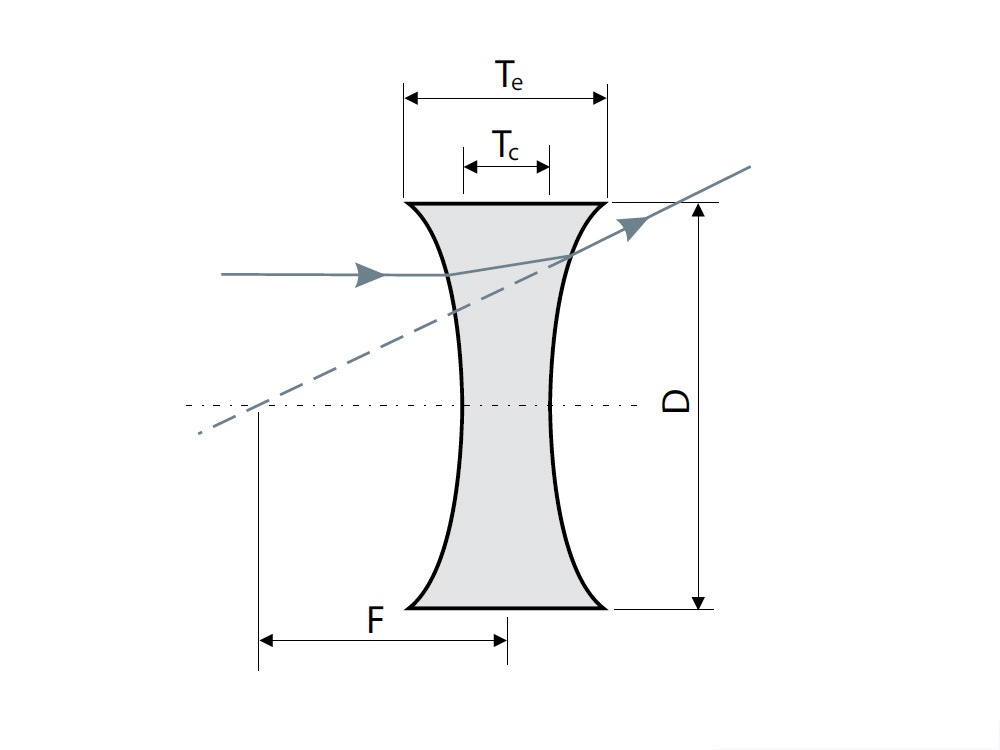
Bi-concave lenses feature two inward-curving surfaces that diverge parallel light rays from a virtual focal point. With negative focal lengths, these lenses are essential for beam expansion, light projection, and focal length adjustment in optical systems. Star-optics manufactures custom bi-concave lenses from optical glass, fused silica, and infrared materials, with anti-reflective coatings optimized for UV, visible, and IR wavelengths.
| Parameter | Factory Standard |
|---|---|
| Material | Optical glass, fused silica, sapphire, etc. |
| Diameter | 2mm – 300mm |
| Diameter Tolerance | ±0.05mm (≤50mm), ±0.1mm (>50mm) |
| Focal Length | -50mm to -2000mm |
| Focal Length Tolerance | ±0.2% (<10mm) ±0.5% (10–1000mm) ±1% (>1000mm) |
| Center Thickness | 2mm – 20mm |
| Surface Quality | 60/40, 40/20 |
| Surface Accuracy | λ/10 @ 632.8nm, 532nm |
| Clear Aperture | >85% of diameter |
| Centration | <3 arc min to 30 arc sec |
| Coating | As per customer’s request |
Selecting the Right Specifications
Focal length affects how the lens bends light. We make bi-concave lenses from -50mm to -2000mm. Short focal lengths are used in small systems, while long focal lengths spread light more gradually for lasers and instruments.
Diameter tolerance matters for how the lens fits in the mount. Our lenses smaller than 50mm have ±0.05mm tolerance, and larger lenses have ±0.1mm tolerance. We make diameters from 2mm to 300mm.
Surface accuracy affects image sharpness. We offer λ/4 for normal imaging, and λ/10 for systems needing very sharp images. Better accuracy costs more but gives better quality—important for lasers and high-resolution cameras. We check every surface before coating.
Bi-Concave vs Plano-Concave Selection
Choosing between bi-concave and plano-concave lenses depends on how you use them. Bi-concave lenses work better when the object and image are at similar distances from the lens. The two curved surfaces spread the optical power evenly, which reduces image problems.
Plano-concave lenses work better when one distance is much longer than the other—like when straightening a spreading light beam. In these cases, put the curved side toward the longer distance to reduce problems. For expanding beams in laser systems, plano-concave lenses often give better results.
When adding lenses to a system with multiple parts, think about where the lens goes. Bi-concave lenses work well in the middle of the system, while plano-concave lenses work better at the edges where light enters or exits at angles.
Custom Manufacturing
we develop bi-concave lenses for specialized requirements including large-aperture systems, miniature optics, and extreme environment applications. Our optical engineering team works with clients from initial design through production, optimizing lens parameters for specific system performance targets.
Each lens undergoes interferometric testing, surface quality inspection, and dimensional verification before delivery. Inspection reports and Certificates of Conformance accompany every order.